
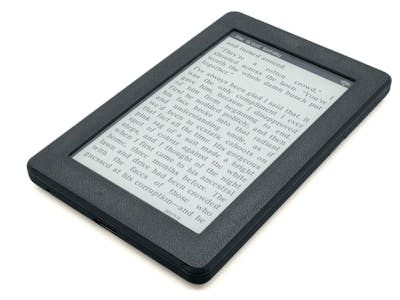
Most e-readers keep drifting toward being tablets, piling on browsers, app stores, and notifications. The Open Book Touch goes the other way on purpose. It boots straight into your current book, draws less than a milliamp while you read, and does nothing else. No ads, no accounts, no pop-ups, and every layer of it is yours to change.
At its core sits an ESP32-S3 microcontroller instead of a full Linux system, which is why it wakes almost instantly and sips so little power. The whole device is open: the firmware ships under an MIT license, and the schematics, PCB files, enclosure CAD, and the new UI framework are all being released too. At $149, it is aimed at readers who want a device they can crack open and tinker with, not a sealed gadget that fights them.
What is packed inside
The reader carries a 4.26-inch, 480 x 800 front-lit E Ink touchscreen in a 10 mm shell that weighs about 85 grams. Warm and cool LEDs dim on separate channels, so the frontlight works in bright daylight or a dark bedroom. A microSD card holds your EPUB and plain-text files, and SQLite quietly manages the library metadata. On the board you get 16 MB of flash, 8 MB of PSRAM, USB-C charging, a user-replaceable battery, plus onboard Wi-Fi and Bluetooth LE. GNU Unifont supplies roughly 70,000 glyphs, and the interface already speaks seven languages, with right-to-left support for scripts like Arabic and Hebrew. Books load over your local network through a browser, so no cloud account is needed.
Build it yourself
Here is what makes it fun for a robotics club or a capstone team: you can treat the Open Book Touch as a premium e-paper development board. Write firmware with ESP-IDF for full control, or reach for Arduino or CircuitPython while you are still learning. The snap-fit enclosure is meant to be reprinted, so swapping in your own case is a weekend job. Want to try the idea before the $149 unit ships in April 2027? An ESP32-S3 dev board and a SPI E Ink panel from circuit.rocks will let you wire the same low-power reading loop on a breadboard first, then port it over. The full write-up and specs are on Hackster.
Frequently Asked Questions
What microcontroller powers the Open Book Touch?
It runs on an ESP32-S3 rather than a Linux system. That choice lets it boot straight into your book and draw under a milliamp while reading, with 16 MB of flash and 8 MB of PSRAM on board.
What file formats and languages does it support?
It reads EPUB and plain-text files from a microSD card, with SQLite managing the library. GNU Unifont provides about 70,000 glyphs, and the interface ships in seven languages, including right-to-left scripts like Arabic and Hebrew.
What will I learn if I build something like this?
You will get hands-on with ESP32-S3 firmware in ESP-IDF, Arduino, or CircuitPython, learn to drive an E Ink panel over SPI, and practice low-power design, microSD file handling, and Wi-Fi transfers. It is a solid capstone-scale project for an ECE or robotics student.
