
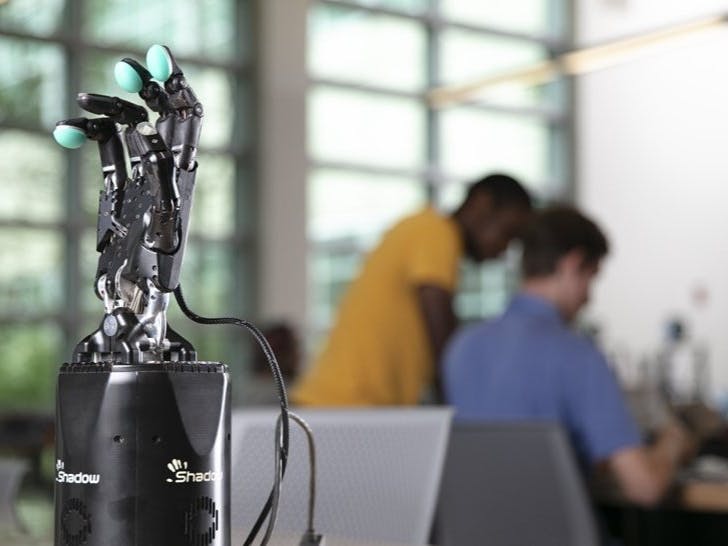
A prosthetic hand can have all the mechanical dexterity in the world and still frustrate the person wearing it. The hard part was never the fingers — it’s the reading of intent. Every user’s muscle signals differ by anatomy, limb loss, and electrode placement, and those signals drift within a single afternoon as muscles fatigue or sensors shift. A control scheme tuned for one person, or even one session, can fall apart in the next. That’s the gap a team at Florida Atlantic University set out to close, and their answer leans on clever sensing rather than brute-force machine learning.
What the FAU team built
Instead of the electromyography (EMG) most prosthetics rely on, the researchers built a custom wearable sleeve packed with magnetic force myography (FMG) sensors. A 3D scan of the user’s residual limb shapes a snug sleeve, and embedded into it are either 18 or 24 sensor modules depending on the person’s anatomy. Rather than reading electrical activity, these sensors watch the muscle physically change shape as the wearer attempts a gesture. Paired with a per-user AI model, the sleeve translates those movements into commands for a dexterous robotic hand.
How the sensing actually works
Each module is beautifully simple: a soft silicone structure holds a small neodymium magnet suspended above a Hall effect sensor. When a muscle contracts, the magnet shifts a fraction of a millimeter and the Hall sensor registers the change. Because it measures mechanical movement instead of skin-surface voltage, FMG shrugs off the classic EMG headaches — sweat, changing skin conductivity, and electrode noise. The researchers even note the sensors keep working underwater. In testing with 10 participants, including three upper-limb amputees, users drove the robotic hand through 19 distinct hand and wrist gestures, with the AI model retrained to each individual.
Build the idea yourself
You don’t need a research lab to explore this. A single Hall effect sensor (like an A1302 or a digital 3144), a tiny neodymium magnet, and a microcontroller are enough to prototype one FMG channel on a breadboard.
- Mount the magnet on a bit of flexible silicone or foam over a muscle belly, with the Hall sensor fixed just beneath it.
- Read the analog value on an Arduino or ESP32 and watch it swing as you flex.
- Add channels, log the data, and feed it into a simple classifier to recognize a few gestures.
Scale that from one channel to a ring of them and you’ve rebuilt the core principle behind a system that’s quietly rewriting how prosthetic hands understand their users.
Frequently Asked Questions
How do the magnetic FMG sensors detect muscle movement?
Each module suspends a small neodymium magnet in soft silicone above a Hall effect sensor. When a muscle contracts and changes shape, the magnet shifts slightly and the Hall sensor reads the change in magnetic field, so the system measures physical muscle motion instead of skin-surface voltage.
Why use FMG instead of the EMG most prosthetics rely on?
EMG reads electrical activity at the skin, which is easily corrupted by sweat, changing skin conductivity, and electrode placement. FMG measures mechanical muscle movement, giving a stronger signal-to-noise ratio and even working underwater, which makes per-user control far more reliable.
What will I learn if I build this?
Prototyping even one FMG channel teaches you how Hall effect sensors and magnets translate physical motion into an analog signal, how to read and filter that signal on an Arduino or ESP32, and the basics of feeding sensor data into a machine-learning classifier to recognize gestures — core skills for robotics, wearables, and embedded ML.
