
Regular GPS is brilliant for getting you across town, but ask it to park a robot on the same tile twice and it falls apart. The GNSS receiver in your phone is only accurate to about 15 feet under a clear sky, which is useless the moment your project needs to know where it is on the scale of a room or a backyard. That gap is exactly why RTK positioning matters, and why it’s suddenly worth a look for makers on a student budget.
A tank robot that always finds its way home
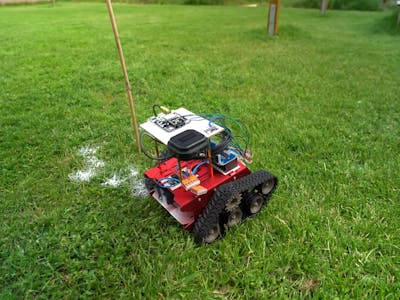
The maker GreatScott! showed the idea off with a small tracked robot roaming his yard. He started with a cheap kit, kept the frame, motors, battery, and tracks, then threw out the stock brains and wired in his own. An ESP32 development board runs the show, driving the motors through H-bridge drivers exactly the way any hobby robot would. The clever part isn’t the drivetrain at all, it’s the positioning hardware bolted on top.
How RTK squeezes half-inch accuracy out of satellites
RTK stands for Real-Time Kinematic, and it rides on the same GNSS satellites everything else uses. The trick is a second receiver: a base station parked at a known, fixed spot. The base measures how far off the satellite signals are, thanks to atmospheric interference and refraction, and radios those corrections to the moving rover. Because both units sit close together and see the same errors, the rover cancels them out and lands accuracy down to roughly half an inch. In testing, the robot returned to a marked point within 20cm, and even that was the robot’s mechanical limit, not the GPS.
What you’d need to build one
The heart of the setup is an ESP32 board, a motor driver, and a chassis kit you can drive. For the positioning side, GreatScott! used ArduSimple’s simpleRTK2B Starter Kit, which bundles everything for both the base and the rover, plus a radio link good for about half a mile. At around $568 it isn’t pocket money, but for a capstone rover, a precision-agriculture demo, or an autonomous-navigation thesis, it’s a serious head start into tech that used to cost thousands. Set your base station, let the rover phone home for corrections, and you’ve got surveying-grade positioning for a weekend project.
Frequently Asked Questions
What hardware gives the robot its centimeter-level accuracy?
An ArduSimple simpleRTK2B kit provides both a fixed base station and a moving rover receiver. The base radios GNSS error corrections to the rover over a link good for about half a mile, letting the rover reach roughly half-inch accuracy.
How much does an RTK GPS robot like this cost to build?
The simpleRTK2B Starter Kit runs about $568, and it bundles the base station, rover, antennas, and radio link. On top of that you only need an ESP32 board, H-bridge motor drivers, and a basic tracked chassis kit.
What will I learn if I build this?
You’ll practice interfacing an ESP32 with motor drivers, reading GNSS data over serial, and setting up a base-and-rover RTK correction link. It’s a strong foundation for autonomous navigation, robotics, and precision-agriculture capstone projects.
