
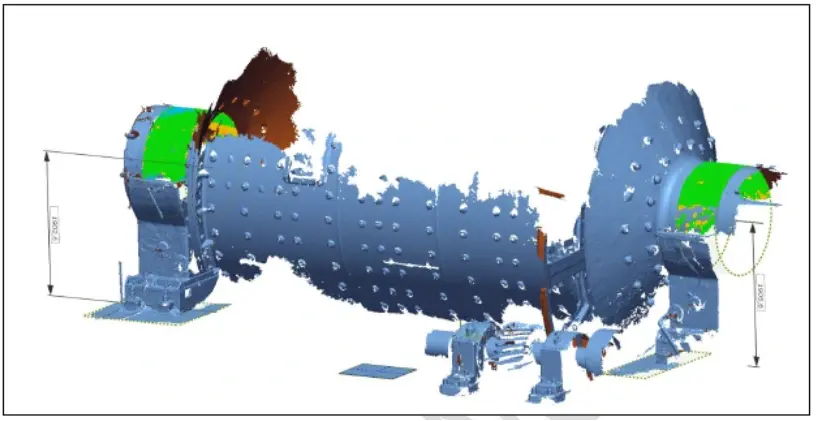
How do you measure a mining machine the size of a small house and still trust the numbers down to a fraction of a millimeter?
That was the puzzle facing Talleres Artificio, a mechanical engineering firm in Chile that services the kind of heavy equipment used in mining. Ball mills, the big rotating drums that grind ore, wear unevenly over years of punishing use, and checking whether one is still within spec used to mean slow, hands-on measurement. By folding a portable 3D scanner into their inspection routine, the team reports cutting the time for certain ball mill checks roughly in half while ending up with richer, more reliable dimensional data than tape measures and calipers ever gave them.
How the scanner actually works
The tool at the center of this is SHINING 3D’s FreeScan Trak Nova, a handheld laser scanner paired with an optical tracker. Instead of touching the part, it sweeps laser lines across the surface while the tracker watches reference markers to know exactly where the scanner is in space. The result is a dense point cloud, essentially millions of measured coordinates, that gets stitched into a 3D model of the real part. Engineers then overlay that model against the original CAD design and generate a color map: green where everything matches, red and blue where the surface has drifted out of tolerance. On something as large as a ball mill, that wide-area capture is what makes the speed-up possible, because you are no longer probing one point at a time.
Try it on a smaller scale
You do not need a mine site to play with this idea. The same workflow, scan a real object, build a mesh, and compare or rework it, scales all the way down to a desktop. Hobby-grade structured-light and laser scanners can digitize a worn bracket, a vintage part with no drawings, or a print that warped, so you can reverse-engineer a replacement or verify a finished piece. The principle is identical to what Talleres Artificio is doing on giant equipment: capture reality as data, then let the comparison tell you what to fix. It is a genuinely useful skill for anyone who repairs, restores, or builds physical things.
Frequently Asked Questions
What scanner did Talleres Artificio use for ball mill inspection?
They added SHINING 3D’s FreeScan Trak Nova, a handheld laser scanner paired with an optical tracker that captures a dense point cloud of the real part without physically touching it.
Why is 3D scanning faster than traditional inspection?
A laser scanner captures millions of surface points across a wide area at once, instead of probing one measurement at a time. That whole-surface capture is what let the firm cut certain inspections roughly in half.
What will I learn if I build this?
Working with 3D scanning teaches you how to turn a physical object into measured data, build and clean a mesh, and compare it against a CAD model to spot where reality drifts from the design. Those reverse-engineering and metrology skills transfer directly to repairs, restorations, and verifying your own prints.
