
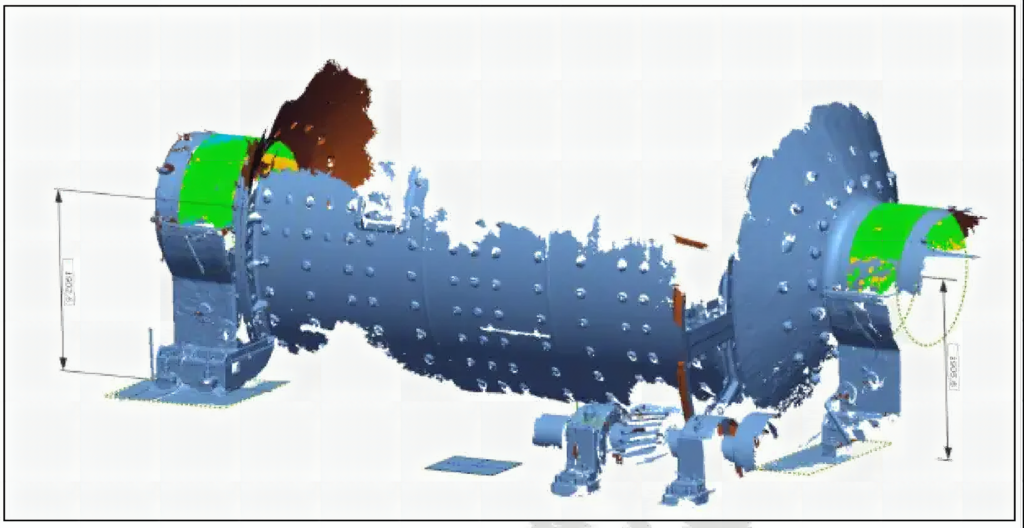
Want to measure a part the size of a small car without dragging it onto a coordinate measuring machine? Here is the shopping list a workshop needs to pull that off: a portable laser 3D scanner, a laptop running metrology software, a set of reference markers or a tracking unit, and a clean reference CAD model to compare against. That kit is exactly what a Chilean engineering firm just leaned on to rethink how it checks worn mining gear.
What the team actually did
Talleres Artificio, a mechanical engineering shop in Chile, added a handheld laser scanner to its inspection line for heavy mining equipment. Instead of measuring a ball mill by hand with calipers and gauges, engineers now sweep the scanner across the surface and capture millions of points in minutes. The firm reports that the new workflow roughly halved the time needed for certain ball mill inspections while giving them richer dimensional data to work from.
How the scanning works
The scanner used here, a FreeScan Trak Nova, pairs laser triangulation with optical tracking so it can map large metal parts without plastering reference stickers across every surface. It fires laser lines at the object, reads how they deform on the surface, and builds a dense point cloud in real time. That cloud gets aligned to the original CAD model, and software paints a color deviation map — green where the part is in tolerance, red and blue where it has worn or warped. For a component that grinds ore all day, knowing exactly where the wear lives is the difference between a planned repair and a surprise failure.
Why this matters for your bench
You do not need a mining contract to put 3D scanning to work. The same triangulation-plus-tracking idea scales down to desktop scanners that hobbyists use to reverse-engineer a broken bracket, digitize a sculpted prototype, or check a 3D print against its source model. If you want to try it, start with a smaller structured-light or laser scanner, learn to clean and align a point cloud, then compare it to a known reference. The mining-grade version just proves how far the technique stretches: from a snapped printer part on your desk to a multi-ton mill on a factory floor.
Frequently Asked Questions
What does Talleres Artificio use the FreeScan Trak Nova for?
The firm uses the handheld laser scanner to inspect heavy mining equipment, especially ball mills, capturing dense dimensional data to spot wear that would be slow and imprecise to measure by hand.
Why is laser scanning faster than traditional inspection on large parts?
It captures millions of surface points in minutes and compares them to a reference CAD model automatically, replacing slow point-by-point caliper and gauge measurements with a single sweep and a color deviation map.
What will I learn if I try 3D scanning this way?
You will pick up the full metrology loop: capturing a point cloud, cleaning and aligning scan data, registering it to a reference model, and reading deviation maps. Those skills carry straight into reverse engineering broken parts and quality-checking your own 3D prints.
