
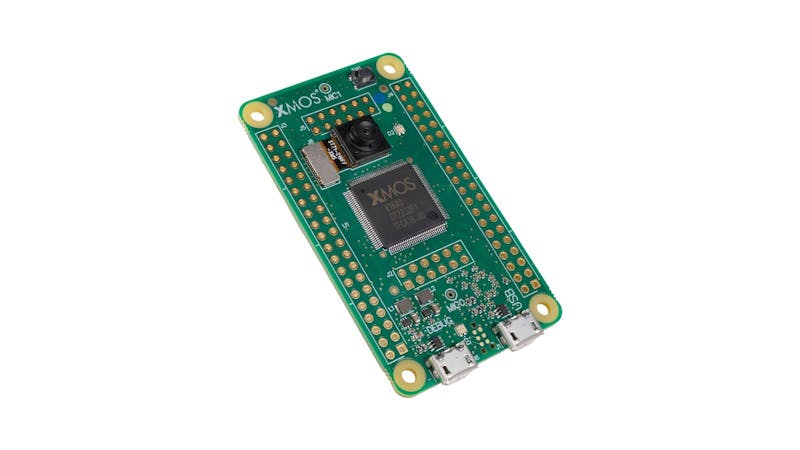
Got a free Saturday and a camera project stuck in limbo? The usual choice is annoying: an ESP32-CAM that stalls the moment you ask for anything past basic frame capture, or a Raspberry Pi that boots slowly and drinks power. XMOS just dropped a third option into that gap with XCORE-VISION, a board small enough to sit on your bench that runs vision AI on-device with no operating system to babysit.
What XMOS actually built
XCORE-VISION is built around the XMOS XCORE.AI XU316, a multicore microcontroller that does hardware-level parallel processing with deterministic timing. That second part matters for robotics and monitoring rigs, where you need to know exactly when a routine fires, not just that it eventually will. The board ships with an 8-megapixel camera sensor already attached, so you can flash firmware and start pulling frames the same afternoon. XMOS has run MobileNetV2 and YOLOv8 on it for object classification, face identification, and logo detection, all locally with no cloud round-trip.
Two digital MEMS microphones ride alongside the camera, which opens the door to multimodal builds that watch and listen at once. Picture a node that flags both a face at the door and the sound of a knock, without shipping either stream off to another computer. The rest of the hardware covers 64 Mbit of QSPI flash, a couple of buttons, an LED, and 3.3 V I/O pins for wiring in external parts. Two Micro USB ports split the load: one for power and debugging, one for USB connectivity, and an integrated XTAG4 interface keeps programming and flashing simple.
The parts-and-cost reality
Here is the honest catch. XCORE-VISION is a Crowd Supply crowdfunding board, so it is not sitting in a drawer waiting to ship today. XMOS plans to open-source the schematics and firmware once units reach backers, and the documentation and application notes are already posted if you want to scope a build now. Compared to bolting an FPGA onto an ESP32-CAM to get real-time timing, a single board that already handles deterministic vision is the cheaper path in both pesos and weekend hours.
If your Sunday brain is already sketching a doorbell that knows faces or a bench camera that sorts resistors by color band, sign up for launch notifications and start mapping which XCORE cores you would hand each task. Read the full breakdown on Hackster: XCORE-VISION Hits the Sweet Spot for Computer Vision Applications.
Frequently Asked Questions
What chip powers XCORE-VISION?
It runs on the XMOS XCORE.AI XU316, a multicore microcontroller with hardware-level parallel processing and deterministic timing, letting the board execute models like YOLOv8 and MobileNetV2 locally without a Raspberry Pi or an operating system.
Can I buy an XCORE-VISION board right now?
Not yet. It is a Crowd Supply crowdfunding board, so you sign up for launch notifications first. XMOS plans to open-source the schematics and firmware once units ship to backers, though the documentation and application notes are already available to plan around.
What will I learn if I build with this board?
You will pick up on-device AI inference, splitting a workload deterministically across multiple cores, interfacing an 8MP camera and MEMS microphones, and working with QSPI flash and 3.3 V I/O. Deploying MobileNetV2 or YOLOv8 on real hardware also teaches how vision models behave outside a tutorial notebook.
