
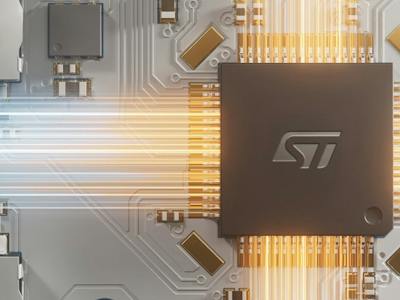
Block off one weekend, grab a cheap STM32 board, and use it to find out why ST’s latest announcement matters to anyone who builds things. STMicroelectronics says it is folding its STM32 microcontroller range into one platform built around Arm Cortex-M cores, so code and tools you learn on a hobby board carry over to industrial, robotics and automotive parts.
What ST actually announced
The pitch is continuity. Move from one STM32 to another without rewriting everything, with the STM32Cube tools and your existing code following you. ST is also working with Arm to shape future Cortex-M designs. Three new STM32A parts, the STM32A4, STM32A5 and STM32A9, target safety-critical and automotive work, and the A5 also fits industrial automation and robotics. They are sampling to customers now, with wider availability planned for next year and no price yet.
The part you can order today is the STM32G5, a real-time power control chip built on a 280 MHz Cortex-M33 core. It starts at $1.034 each in 10,000-unit quantities, so a single piece costs more, but it shows where the line is heading. The original coverage is on Hackster.
The parts and cost reality
You do not need the new silicon to try this. A weekend budget looks like this:
- Any STM32 dev board with a USB debug probe built in, usually a few hundred pesos up to about PHP 1,500 depending on the line.
- A USB cable, an LED and a 330 ohm resistor on a breadboard.
- STM32CubeIDE, which is free and generates the pin setup code for you.
The first gotcha is clock configuration. Cube sets it through a graphical tree, and a wrong PLL multiplier is the usual reason a first blink sketch runs at the wrong speed or not at all. The second is that pin names like PA5 map to board silkscreen labels differently on each board, so check the user manual before you wire a GPIO.
Spend your Sunday on this
Saturday: blink an LED on one STM32 board and read a sensor over I2C, with the SDA and SCL lines pulled up to 3.3V. Sunday: take the same project to a second STM32 family and count how many lines of the library code you had to change. That count is the whole point of ST’s pitch, and you can judge it with your own hands.
If you are working on a capstone or a robotics team entry, an STM32 gives you the same toolchain used in commercial products. Pick a board from the STM32 range and check what is in stock at Circuit.Rocks before you plan the weekend.
Frequently Asked Questions
What did STMicroelectronics announce for STM32?
ST is unifying the STM32 family around Arm Cortex-M cores so software and tools carry across industrial, robotics and automotive parts. It also introduced the STM32A4, A5 and A9 for safety-critical use, plus the STM32G5 for real-time power control.
Can students buy the new STM32 chips now?
The STM32G5, a 280 MHz Cortex-M33 part, is available to order now, with pricing from $1.034 each at 10,000 units. The STM32A family is only sampling to customers, with broader availability planned for next year and no announced price.
What will I learn if I build this?
You learn clock setup, GPIO pin configuration and I2C wiring in STM32CubeIDE, and you see how portable your code is between two STM32 families. Those skills transfer to thesis projects, robotics competitions and embedded jobs.
