
The parts list for a homebrew RF signal generator is shorter than most students expect: an ADF4351 breakout board, any 8-bit micro that can talk SPI, a 3.3V regulator, and an SMA pigtail. Wire SCK, MOSI and a chip-select pin from the micro to the synthesizer, push six 32-bit registers over SPI, and you have a programmable carrier on your bench. CircuitValley took that same recipe, cleaned up the RF layout, and turned it into a product called the RFGEN44.
What CircuitValley actually built
The RFGEN44 is a Crowd Supply campaign for a tested, production-ready version of that idea: a Microchip PIC16 driving an Analog Devices ADF4351 wideband synthesizer, packed into a chassis measuring 81 x 47 x 26 mm and weighing 65 g. It runs off USB Type-C and enumerates as a USB HID device, so there is no driver to install and no vendor software to fight with. Founder Gaurav Singh built it so the whole chain stays readable, from the schematic through the firmware that bridges USB packets to the ADF4351 over SPI. Design files and source sit on GitHub under a CC BY-NC-ND license, so read the terms before you fork it into anything commercial.
The numbers that matter
Output covers 35 MHz to 4.4 GHz in 10 kHz increments. Amplitude tops out near -1 dBm from 35 MHz to 1 GHz, 0 dBm up to 2 GHz, and 4 dBm at the top of the range, which makes it a source for filter sweeps, receiver alignment and LO injection rather than a transmitter. There is a jack for an external reference clock, and that is the detail most first-time builders skip. The on-board oscillator sets your frequency accuracy, so feeding in a disciplined 10 MHz reference is what separates a hobby generator from something you can defend in a thesis. A sync output lets you trigger a scope on every frequency change. Backer price is $139, with shipping estimated for January 2027.
Breadboard it before you back it
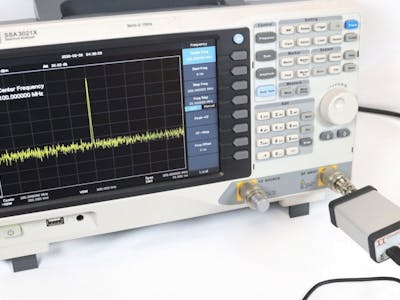
Get an ADF4351 module talking to an Arduino or a Pico first. The tricky part is register order: the chip expects R5 written down to R0 on initialization, and getting that sequence wrong leaves the PLL unlocked with nothing on screen to explain why. Watch the LD pin instead of guessing at the output. Once you can command 100 MHz on demand and confirm it on a scope, you will know whether $139 for a shielded, calibrated box earns its place in your lab, or whether your own board is already good enough for the capstone. Start with the register map in Analog Devices’ ADF4351 datasheet, then read the full campaign write-up on Hackster.
Frequently Asked Questions
What chips are inside the RFGEN44?
A Microchip PIC16 microcontroller drives an Analog Devices ADF4351 wideband synthesizer over SPI. The PIC16 also handles the USB HID link, so the generator works driver-free and outputs 35 MHz to 4.4 GHz in 10 kHz increments.
Can I build an ADF4351 signal generator myself instead of buying one?
Yes. A bare ADF4351 breakout, a Pico or Arduino for SPI, a 3.3V regulator and an SMA pigtail get you a working programmable source for a fraction of the RFGEN44’s $139 price. What you give up is the shielding, the calibrated amplitude steps and the external reference input, which start to matter above 1 GHz.
What will I learn if I build this?
You will get hands-on with SPI register programming, since the ADF4351 needs six 32-bit registers written in the right order before the PLL will lock. You will also learn to read the lock-detect pin for debugging, work through an RF datasheet, and understand why reference-clock accuracy and ground-plane layout decide whether an RF board actually performs. Those skills carry straight into communications labs and capstone projects.
