
Here is a short parts list for a spooky prop that reacts to people: one Raspberry Pi Pico, one HC-SR04 ultrasonic sensor or PIR motion sensor, a hobby servo, and a store-bought Halloween decoration to hide it all in. That combination covers most of the projects in Raspberry Pi Official Magazine’s Pico Halloween roundup.
What the roundup builds
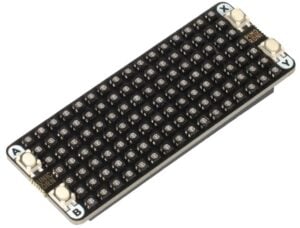
The simplest upgrades are lighting. Pimoroni’s Pico Unicorn Pack is an LED board with buttons that is barely bigger than the Pico itself, and the Plasma 2350 W pairs a Pico 2 W-style board with a programmable LED strip you can tuck into a skull bottle or a plastic pumpkin.
The DIY entries add motion. Kevin McAleer’s skeleton robot uses ultrasonic sensors as “eyes” and moves its mouth and eyebrows when someone steps in front of it. Maker 314Reactor hacked a supermarket bag of bones with a PIR sensor, motors, and a speaker that plays Bach’s Toccata and Fugue in D minor. A George Washington portrait follows you around the room using ultrasonic sensors and servos that slide a piece of card behind the frame, with no computer vision involved.
Technical notes before you wire it
The Pico‘s GPIO pins run at 3.3V, while an HC-SR04 echo pin outputs 5V. A voltage divider (1k and 2k resistors works) on the echo line keeps the pin safe, and it is the first gotcha most students hit. Servos should draw from their own 5V supply, with grounds shared with the Pico, because a stalled servo can pull several hundred milliamps and reset the board.
A PIR sensor is simpler to code than ultrasonic: one digital input goes high when it sees motion. Ultrasonic gives you distance, so you can trigger the scare only when someone is within, say, 100 cm. Both run fine in MicroPython with a short polling loop.
Wrap-up: pick one trigger and one output
Start with a PIR on one GPIO pin and an LED strip as the output, then add a servo once that works. For a school booth or a barangay trick-or-treat table, one sensor and one moving part is enough to get screams. Read the full list of projects and links at the Raspberry Pi news post, and check the Pico boards at circuit.rocks if you need one for the weekend.
Frequently Asked Questions
What triggers the scares in these Pico Halloween projects?
Most use an ultrasonic distance sensor or a PIR motion sensor wired to a Pico GPIO pin. When someone is detected, the Pico moves servos, plays audio, or changes LED colors.
What parts and skills do I need to build one?
A Pico, one sensor, a servo or LED strip, a separate 5V supply for motors, and basic MicroPython. A breadboard is enough for prototyping before you fit it into a decoration.
What will I learn if I build this?
You will learn digital input from sensors, 3.3V versus 5V logic levels, voltage dividers, driving servos with PWM, and how to power motors without resetting the microcontroller.
