
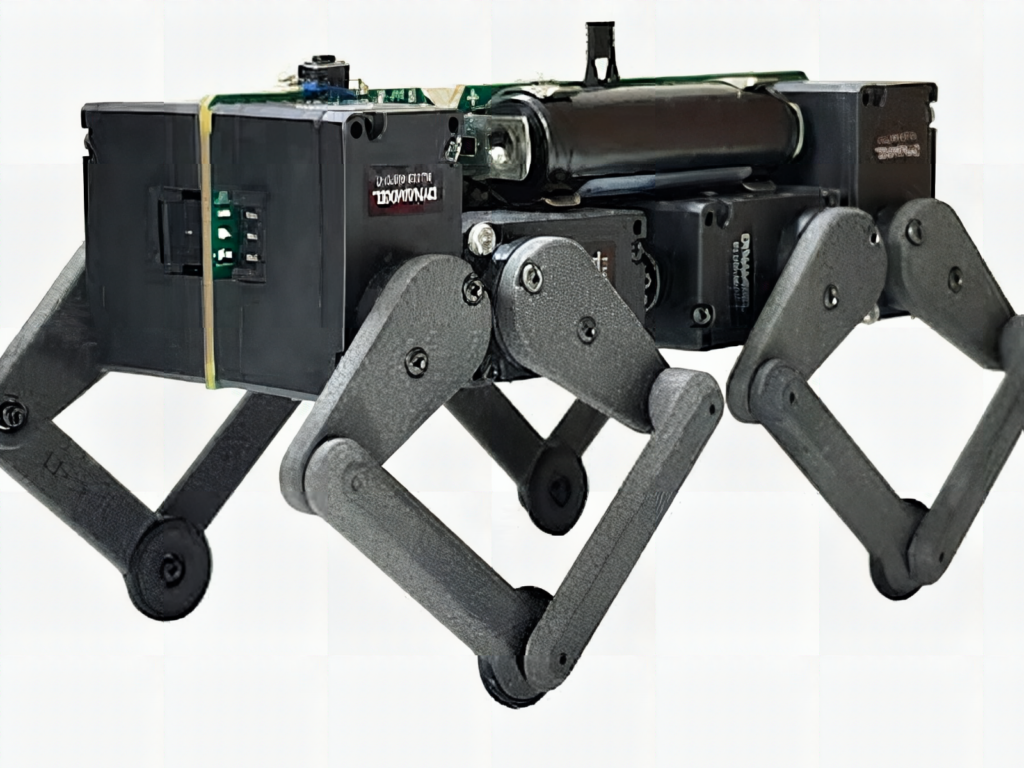
Capable robotics and a low price tag almost never show up in the same package. The original Q8bot proved a palm-sized quadruped could trot and jump for relatively little money, but there was a catch that kept most makers on the sidelines: you had to source every part and build it yourself. The new Q8botOne erases that barrier, and that is why it matters — dynamic legged robotics is finally becoming something you can just unbox.
Created by Eric Wu, Q8botOne is the follow-up to that earlier open source design. It is a four-legged robot small enough to sit in your palm, yet it walks, trots, and jumps straight out of the box. Where the first version was a parts-sourcing marathon, this one ships fully assembled through a Crowd Supply campaign, so the only step between you and a working robot is clicking order.
What’s under the shell
Rather than threading cable bundles through the body, Q8botOne integrates all of its electronics onto a single central PCB, which cuts weight, improves reliability, and keeps the build looking clean. Motion comes from eight DYNAMIXEL XL-series actuators driving lightweight parallel-linkage legs made from MJF 3D-printed parts and ball-bearing joints. An ESP32-C3-MINI-N4 handles the onboard processing, powered by a rechargeable lithium-ion pack with built-in protection. Each unit also ships with a pre-paired wireless controller dongle sporting a joystick, buttons, and USB-C.
Make it your own
The whole platform stays open source, just like its predecessor. A Qwiic-compatible connector lets you bolt on sensors from the likes of SparkFun and Adafruit, while a UART interface can feed a co-processor such as a Raspberry Pi with up to 5V at 3A. If you would rather build a version yourself, the ingredients are no secret: an ESP32-C3 board, a set of small smart servos, 3D-printed linkage legs, and a protected li-ion cell. Mechanical files live in Onshape, and the firmware and hardware will land on the ZeroWireRobotics GitHub once the campaign wraps. That openness is the real draw: whether you buy the finished bot or remix the design, you end up with a hackable platform instead of a sealed gadget. For anyone who has wanted to experiment with legged locomotion without a soldering-heavy weekend, Q8botOne lowers the entry fee to almost nothing.
Frequently Asked Questions
What microcontroller and actuators power the Q8botOne?
It runs on an ESP32-C3-MINI-N4 and moves using eight DYNAMIXEL XL-series smart servos driving lightweight parallel-linkage legs, all wired to a single central PCB.
Can I add sensors or a Raspberry Pi to the Q8botOne?
Yes. A Qwiic connector accepts sensors from SparkFun, Adafruit, and others, and a UART interface can drive a co-processor like a Raspberry Pi with up to 5V at 3A.
What will I learn if I build a quadruped robot like this?
You’ll pick up legged-locomotion basics, smart-servo control, parallel-linkage mechanics, ESP32 firmware, PCB-based wiring, and how to integrate sensors over Qwiic and UART.
