
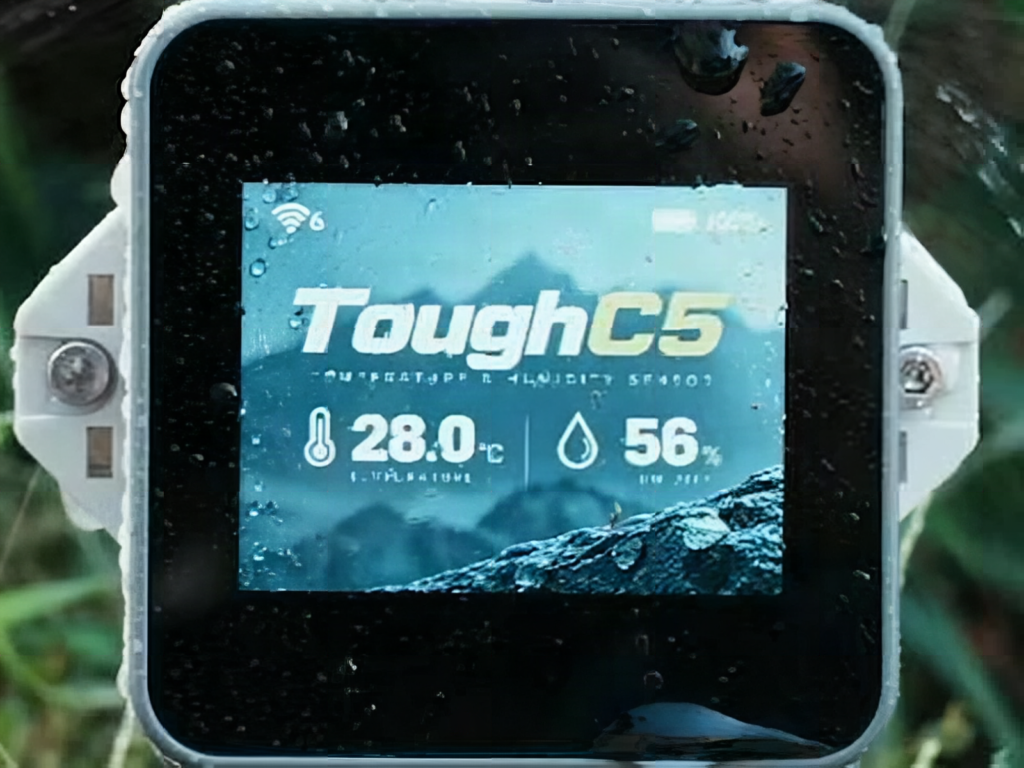
Rain, dust and a hot enclosure kill more field projects than bad code does. An ESP32 board that works fine on your desk can corrode, fog up or brown out after one monsoon week on a rooftop. M5Stack’s new ToughC5, covered by Hackster, is built for exactly that situation, and it costs $49.90 (roughly PHP 2,800 before shipping).
What M5Stack packed in
The ToughC5 replaces the 2021 TOUGH with an ESP32-C5, a single-core RISC-V chip running up to 240 MHz, with 16 MB flash and 8 MB PSRAM. The big change is radio: dual-band 2.4 GHz and 5 GHz Wi-Fi 6, Bluetooth 5 LE, and 802.15.4 for Zigbee and Thread. A 2-inch 320×240 IPS touchscreen reaches 853 nits, so it stays readable in sunlight. A buzzer, a microSD slot and an RX8130CE RTC on a CR2032 cell round out the board.
The technical details that matter outdoors
The UV-resistant PC+ABS case measures 75.9 x 58 x 42.5 mm and has two M12 cable openings. M5Stack calls it water and dust resistant but gives no IP rating, so do not submerge it. Four HY2.0-4P ports expose RS485, I2C, UART and GPIO. Power can come from USB-C, a 6-24 V input on the RS485 side, or a 3.7 V battery. Shutdown draw is listed at 10.41 µA, which matters when a battery has to last a season. Code runs through the Arduino IDE with the M5Unified and M5GFX libraries; UiFlow2 support is still in development.
Build it yourself
A good first project for a thesis or capstone: an RS485 soil moisture probe on one HY2.0 port, logging readings to the microSD with RTC timestamps, then sending summaries over Wi-Fi 6 to an MQTT broker. A gotcha to watch for is the 5 GHz band, since many school routers only broadcast 2.4 GHz, so check your access point before debugging your code. Specs and ordering details are on the Hackster write-up; compare against a plain ESP32 board at circuit.rocks to see whether the rugged case is worth the extra pesos for your deployment.
Frequently Asked Questions
What chip and wireless features does the ToughC5 use?
It uses an ESP32-C5 RISC-V chip at up to 240 MHz with dual-band Wi-Fi 6, Bluetooth 5 LE and 802.15.4 for Zigbee and Thread.
How is the ToughC5 powered and how weatherproof is it?
Power comes from USB-C, a 6-24 V RS485 input or a 3.7 V battery. The PC+ABS case is water and dust resistant with no published IP rating, and it is not meant for immersion.
What will I learn if I build this?
You will learn RS485 and I2C sensor wiring, RTC-stamped data logging to microSD, low-power design, and sending field data over Wi-Fi 6 to an MQTT broker.
