
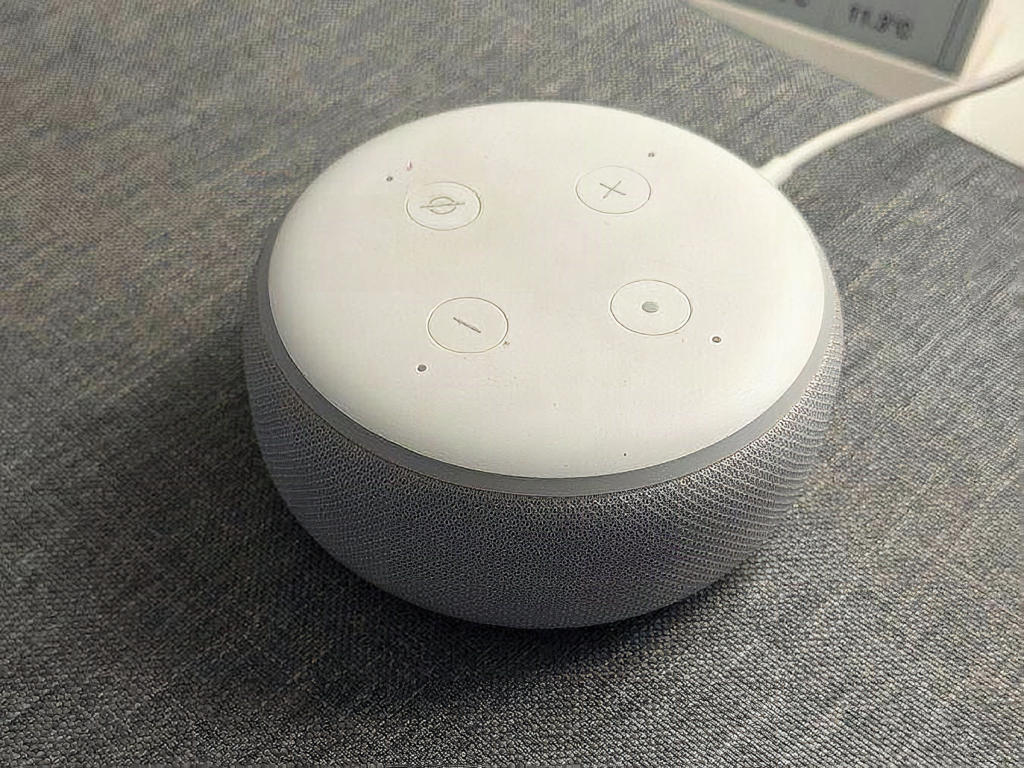
Smart speakers pile up in drawers once people stop trusting what the microphone does with their voice. A growing set of maker projects gives that spare hardware a second job, and the LocalDot from Italian open hardware studio AAElectronics is one of the cleanest examples yet.
What the LocalDot swaps out
LocalDot is a drop-in replacement mainboard for the third-generation Amazon Echo Dot. You keep the original case, buttons, LEDs, speaker, and four-microphone array. Only the PCB changes, and with it the Alexa cloud connection is replaced by a voice assistant that talks to a Home Assistant server on your own network.
Inside the board
An Espressif ESP32-P4 works as the dedicated audio processor, while an ESP32-S3 handles control and networking. A Texas Instruments TAS5805 amplifier drives the stock speaker, and the board supports all 4 microphones with acoustic echo cancellation, so the device can hear a wake word while it is playing music. After the wake word, speech goes to your local server only. Timers, voice notes, and device control keep working during an internet outage, and the unit can double as an intercom between rooms.
The gotcha for now: the firmware and design files are still being prepared, and the license has not been named. A crowdfunding campaign is planned on Crowd Supply, so treat this as a build to watch rather than one to order.
What to try next
You do not need to wait to practice the same idea. Home Assistant already supports local voice through Wyoming satellites, and an ESP32-S3 board with an I2S microphone (INMP441 on GPIO 4, 5, and 6 is a common wiring) plus a MAX98357A amplifier makes a working satellite on a breadboard for under PHP 1,500. Run Whisper and Piper on a Raspberry Pi 5 as the local brain. Thesis teams working on IoT can use this as a privacy-first voice interface for classroom automation. Read the original coverage on Hackster, then pick up an ESP32-S3 board and a Raspberry Pi 5 at circuit.rocks.
Frequently Asked Questions
Which chips does the LocalDot use?
An ESP32-P4 acts as the audio processor and an ESP32-S3 handles control. A TI TAS5805 amplifier drives the original Echo Dot speaker, and the four-microphone array supports echo cancellation.
Does the LocalDot work without internet?
Yes, as long as your Home Assistant server is running. Timers, voice notes and smart-home control stay on your local network, and only the wake word stage runs on the device itself.
What will I learn if I build this?
You will learn I2S audio wiring, wake-word detection, Home Assistant voice pipelines with Whisper and Piper, and how to keep an IoT device local-first, which fits a thesis or capstone on smart-home privacy.
