
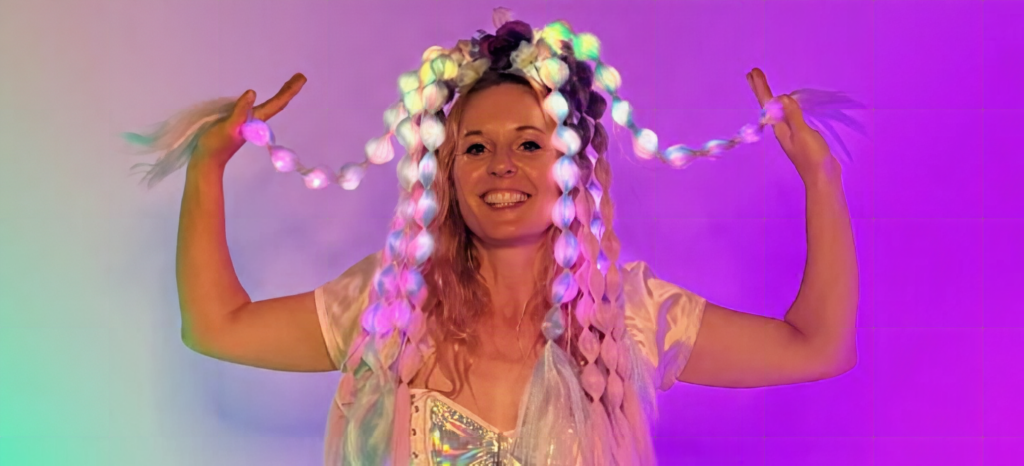
Got a free Saturday and a soldering iron? Erin St Blaine’s LED bubble hair extensions are a weekend build that ends with a wearable you can actually show off at a festival, cosplay meetup, or school fair. Six strands of tiny NeoPixel seed pixels are braided into a hair extension, and a quick head shake turns a soft color gradient into falling rain and, with a harder shake, lightning.
What she built
The brain is an Adafruit RP2040 Prop-Maker Feather. Its onboard LIS3DH accelerometer reads head motion over I2C, so there is no extra sensor to wire up. A gentle shake sends staggered droplets down the individual strands. A stronger shake fires a lightning flash and a faster, denser storm. The animations run on CircuitPython, which means you tweak colors, speed, and shake sensitivity by editing a text file on the CIRCUITPY drive instead of reflashing firmware. The full walkthrough is in the Adafruit Learn guide.
Parts and reality check
Expect to buy the Prop-Maker Feather, a LiPo battery, and a few strips of 2020 RGB seed pixels (each LED is only 2 mm by 2 mm and runs at 5 V logic, so check your power budget). Six strands with a few dozen pixels each add up quickly: at roughly 60 mA per pixel at full white, you will cap brightness in code so a small 500 mAh to 1000 mAh battery lasts through a night. The gotcha is the soldering. Seed pixels have tiny pads, so tin your wires first and test each strand before braiding anything into hair. Adafruit rates it as not beginner friendly for that reason.
Spend your Sunday on this
Saturday, solder and test the six strands on a breadboard with the Feather. Sunday, load the CircuitPython library bundle, adjust the shake threshold, and braid the pixels in. For a school or ECE class, swap the rain effect for a heartbeat or battery meter and you have a neat wearable-electronics demo. Parts like NeoPixel strips and Feather boards are listed on circuit.rocks, and the guide above has the exact code and wiring diagram to copy.
Frequently Asked Questions
How does the hair detect a head shake?
The Adafruit RP2040 Prop-Maker Feather has an onboard LIS3DH accelerometer on I2C. CircuitPython reads its motion data and triggers rain or lightning animations when the shake passes a threshold.
How hard is this build and what skills does it need?
Adafruit says it is not for beginners because the seed pixel pads are tiny and need careful soldering, plus some software setup. Anyone with basic soldering experience can manage it over a weekend.
What will I learn if I build this?
You practice fine-pitch soldering, driving addressable LEDs, reading an I2C accelerometer, and tuning thresholds in CircuitPython. It also teaches power budgeting for battery-powered wearables.
