
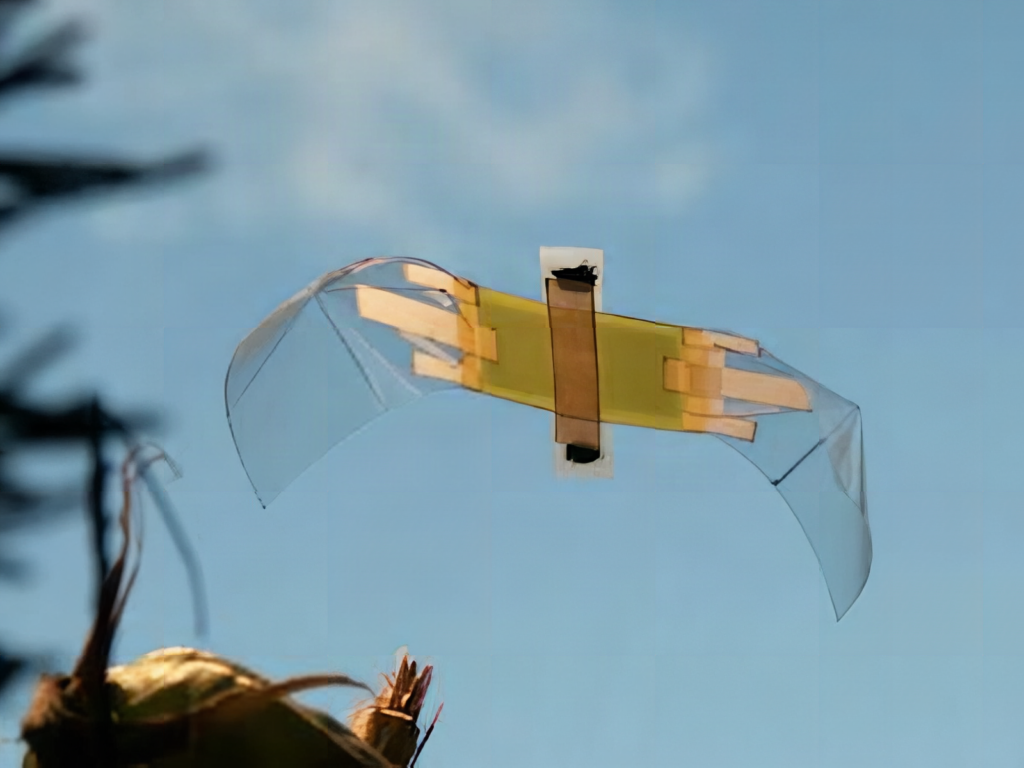
Most micro drones die the first time they hit a wall. A new insect-sized robot from UCLA and UC Davis shrugs off a flyswatter hit and keeps flapping, which matters because fragility is the main reason tiny flyers stay in the lab. The team’s write-up in Science Robotics is summarized on Hackster.
What the researchers built
The robot weighs 185 milligrams, lighter than a paperclip, yet its wings lift three times that weight. There is no motor and no gear train. A thin film of relaxor ferroelectric polymer acts as an artificial muscle: apply an electric field, the film changes shape through electrostriction, and the bending drives two flexible cone-shaped wings directly. Because every part is soft, the airframe survives a swat and even a load around 11,000 times its own mass.
Technical details
The actuator bends 136 degrees at 110 Hz with a power density of 1,600 W/kg. In flight tests the wings beat at 30 Hz, giving a lift-to-weight ratio of 3.0 and 8.3 mN of lift per watt. The climb rate averaged 40 cm/s. The catch: the prototype is tethered, so power arrives over thin wires, and there is no onboard sensor or flight controller yet.
That tether is the tricky part for anyone copying the idea. Driving an electrostrictive film needs a high-voltage supply and fast switching, far from what a 3.3 V GPIO pin can source. Hobby builds would need a boost converter and a MOSFET driver stage.
Build it yourself
You will not 3D-print this wing, but you can practice the control side. Take an ESP32 and an MPU6050 IMU on I2C (SDA on GPIO21, SCL on GPIO22), then write a complementary filter that reads pitch and roll at 100 Hz. That is the same loop a future autonomous insect robot needs. For a robotics class or thesis, a flapping-wing test stand with a load cell is a manageable scope. Boards and sensors are stocked at circuit.rocks, with ESP32 dev boards starting around PHP 350, and the full paper details are linked from the Hackster article.
Frequently Asked Questions
How does this flying robot flap its wings without a motor?
A thin relaxor ferroelectric polymer film bends when an electric field is applied. That bending, 136 degrees at 110 Hz, moves two flexible wings directly with no gears.
Can a hobbyist build this robot?
Not easily. The prototype is tethered and needs a high-voltage drive for the polymer film, plus lab-made actuators. Hobbyists can practice the flight-control side with an ESP32 and an IMU.
What will I learn if I build this?
A related student project teaches IMU sensor fusion, I2C wiring, PWM or driver circuits, and how to test lift with a load cell, all common in robotics theses.
