
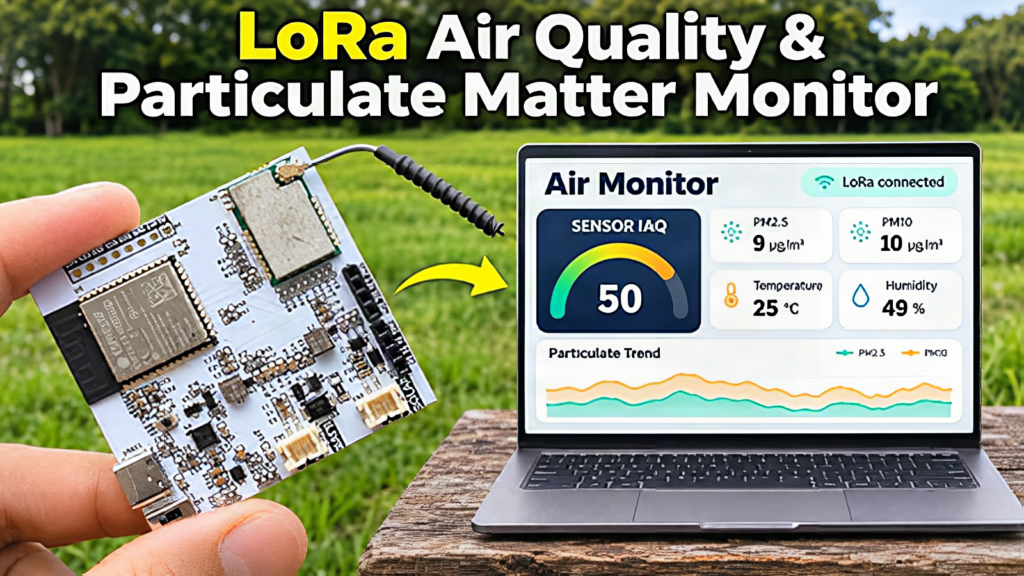
Metro Manila’s air gets measured at a handful of official stations, which tells you almost nothing about the street outside your school or the room where you sleep. A monitor you can hang outdoors and read from inside, with no cloud account and no monthly fee, closes that gap. That is what makes this build from How To Electronics worth copying: it is a complete, open sensor network in miniature, and every piece of it is a skill an ECE student needs anyway.
What the project does
The system is two custom ESP32-S3 boards. The outdoor transmitter carries a Plantower PMS7003 particulate sensor (PM1.0, PM2.5 and PM10 in µg/m³) and a Bosch BME680 for temperature, humidity, pressure and gas resistance. Bosch’s BSEC2 library turns the raw gas reading into an IAQ index plus estimated CO₂ and VOC values. Every 15 seconds the board sends a packet over LoRa to an indoor receiver, which joins your Wi-Fi and serves a dashboard with gauges, trend graphs, dew point, heat index and alert thresholds. In testing the link held at almost 1 km, which covers a campus or a barangay from a single sensor.
Under the hood
- Radio: an E22-900M22S LoRa module on each board, wired over SPI and driven by RadioLib, with 915 MHz antennas. The module covers 850 to 930 MHz, so you can retune it to the 923 MHz AS923 plan used in the Philippines with one line in code.
- Power: the transmitter runs from a 3.7 V, 5,200 mAh Li-ion cell charged by a BQ25185 that accepts both solar and USB input. A 5 V boost feeds the PMS7003 and a 3.3 V buck feeds the ESP32-S3. The receiver uses an MCP73831 charger and a 3.3 V buck-boost.
- Power gotcha: there is no deep sleep. The PMS7003 fan has to keep spinning for valid readings, so the firmware instead kills Wi-Fi and Bluetooth and drops the CPU to 80 MHz. Budget your solar panel for that.
- Storage: readings go to LittleFS on the receiver, so history survives a reboot, and a built-in logger exports CSV for Excel or a thesis appendix.
- Headers: the outdoor board exposes I2C (BME680), UART (PMS7003) and spare GPIO pins, so adding a rain or UV sensor later is a solder job, not a redesign.
Build it yourself
The boards were drawn in EasyEDA and the schematics, PCB files and Arduino sketches have all been released, so a capstone team can order the boards and reflow them, or prototype the same circuit on a breadboard with an ESP32-S3 DevKit, a LoRa breakout and the two sensors. One wiring note: the receiver’s USB-C port is charge-only, so you flash it through the FTDI header, not the USB jack. Start with the walkthrough on Geeky Gadgets, watch the full teardown on YouTube, and if you skip the custom PCB, start by getting the PMS7003 talking over UART at 9600 baud before you touch the radio.
Frequently Asked Questions
How does the outdoor sensor get its data indoors without Wi-Fi?
Each board carries an E22-900M22S LoRa module driven by RadioLib. The transmitter sends a packet every 15 seconds at 915 MHz and the receiver, which does have Wi-Fi, serves the dashboard on your local network. Tested range was almost 1 km.
What parts and skills do I need to replicate it?
Two ESP32-S3 boards, two LoRa modules, a PMS7003, a BME680, a 3.7 V Li-ion cell, a small solar panel and a BQ25185 or similar charger. You need Arduino IDE, basic SPI/I2C/UART wiring and, for the custom PCB route, EasyEDA plus reflow or hand soldering.
What will I learn if I build this?
Point-to-point LoRa radio with RadioLib, driving UART and I2C sensors on one MCU, solar battery charging and power budgeting without deep sleep, storing data in LittleFS and serving a live web dashboard from an ESP32. It is a complete environmental-sensing thesis in one project.
