
A tube radio sits on a shelf, warm to the touch for decades, and then the local AM station goes dark. The dial still glows, the speaker still hums, and there is nothing left to tune. That is the problem GarethDaviesLondon decided to fix with an ESP32-S3 and a coil of wire.
What he built
His small AM transmitter pulls an internet radio stream over Wi-Fi and re-broadcasts it so a vintage set can pick it up on its own dial. The write-up is on Hackaday at hackaday.com. His demo transmits at 200 kHz, which suits the European long wave band, and a medium wave frequency should be possible with the same idea.
How the radio signal gets made
There is no RF chip here. The ESP32-S3 pushes a pulse chain out of a single GPIO pin, and the timing of those pulses forms the carrier with the audio riding on top. Generating radio or video signals from a plain microcontroller pin is an old trick, so the tricky part is getting enough of that signal into the air from one pin.
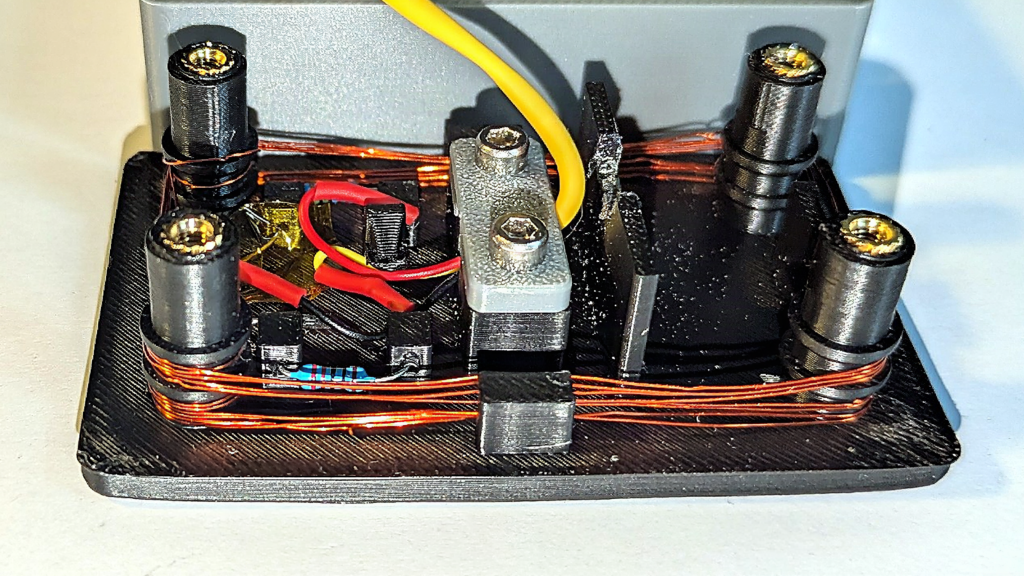
His answer is a printed box with stand-offs that hold a widely spaced wire coil. The coil acts as the antenna, and at that tiny power it is enough for a radio a few feet away. The gotcha is range: more power means more legal trouble, so keep it close.
The takeaway
The lesson is that a 240 MHz dual-core chip can fake a transmitter with nothing but a pin, a library for streaming audio, and some patience with timing. Check your local rules before you transmit anything, since unlicensed broadcasting is regulated in most countries, the Philippines included. If you want to experiment safely, start by generating a 1 kHz tone on one GPIO, view it on a scope, and only then add the stream. ESP32 boards start around PHP 350 at circuit.rocks.
Frequently Asked Questions
How does the ESP32-S3 transmit AM without an RF chip?
It outputs a pulse chain on one GPIO at a carrier frequency, 200 kHz in the demo, and varies it with the audio from an internet stream. A wire coil then radiates enough signal for a nearby radio to pick up.
What parts and skills does this need?
An ESP32-S3 board, a wire coil on a printed or improvised frame, Wi-Fi access for the stream, and comfort with timing-critical code. A scope or a spare receiver helps with debugging.
What will I learn if I build this?
You learn how carriers and modulation work, how to generate precise pulse trains on a GPIO, how antennas radiate, and why broadcasting rules exist, which is useful groundwork for ECE coursework.
