
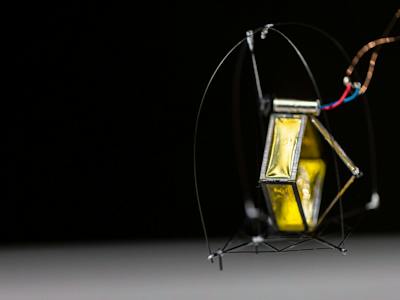
Jumping is one of the most efficient ways for a tiny robot to cross rough ground, but most micro-jumpers rely on springs that release stored energy all at once, which makes the height hard to control and adds mechanical complexity. A team of researchers just published a fix that swaps the spring for a plain DC motor, and it matters for anyone building small robots that need to clear obstacles without wheels or legs.
What DirectHop actually does
DirectHop is a 50 mm, 1-gram jumping robot built around an 820 mg coreless DC motor. Instead of winding a spring, the motor drives a 40 mm-travel Sarrus linkage made from carbon fiber composites directly. Two strands of fishing line act as a spool: one winds in during launch, pulling the linkage and firing the robot upward, and the second reverses the motor afterward to reset it for the next jump. Because the motor pushes the linkage in real time instead of releasing pre-stored energy, the team can dial the jump height up or down just by changing the current.
The numbers behind the control
Motor torque scales with current, and the linkage turns that torque straight into ground force, so more current means a higher jump. Testing showed a tight linear relationship between commanded current and jump height (R² of about 0.98), topping out at a 28.6 cm center-of-mass jump and scaling down to hops under 5 mm with small added feet. A carbon-fiber roll cage lets DirectHop land in any orientation and self-right by shifting its own mass, since the motor alone is over 80% of the robot’s weight, with a 9-out-of-10 success rate and a 4-second average recovery time.
Try the concept on your own bench
You don’t need a 50 mm robot to play with this idea. Grab a coreless DC motor, an Arduino with PWM output, and a current-sense resistor on a breadboard, then log motor current against a measured jump or lift height. That’s the same current-to-force relationship DirectHop’s team used to hit that 0.98 R². It’s a solid capstone-project rig: control theory, a mechanical linkage, and a real regression to fit at the end. Read the full writeup and watch the test footage at Hackster.io.
Frequently Asked Questions
How is DirectHop different from other jumping robots?
Most micro-jumpers store energy in a spring and release it all at once, so the jump height is fixed by how much the spring was wound. DirectHop uses a coreless DC motor to push a carbon-fiber linkage directly, so the jump height can be set in real time just by changing the motor current.
What parts and mechanism make DirectHop’s jump work?
The robot is 50 mm across and weighs about 1 gram, built around an 820 mg coreless DC motor driving a 40 mm-travel Sarrus linkage. Two lines of fishing line spool on and off the motor shaft to fire the jump and then reset the mechanism, and a carbon-fiber roll cage lets it self-right after landing in nine out of ten trials.
What will I learn if I study a build like this?
You get hands-on practice with motor current control (PWM plus a current-sense resistor), a mechanical linkage that converts rotation into straight-line motion, and how to fit a regression line (R²) to real sensor data, which is a common requirement for a physics or engineering capstone project.
