
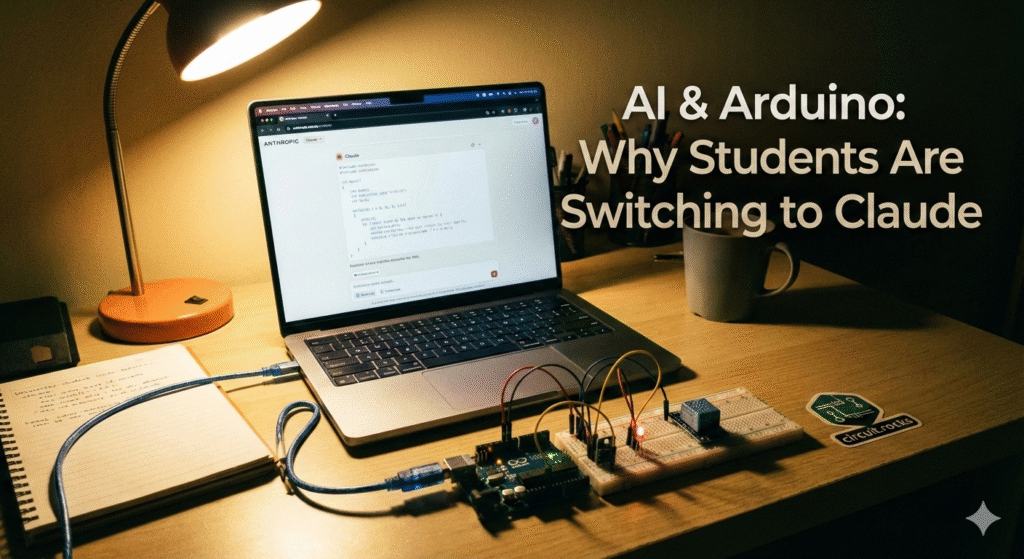
Tired of Buggy AI Code? Why Claude is the New Secret Weapon for Arduino Students
If you’ve ever asked an AI to write an Arduino sketch only for it to suggest a library that doesn’t exist or pins that don’t work, you know the struggle.
For a long time, ChatGPT was the default. But lately, in the labs and dorm rooms where the best projects are built, there’s a new name coming up: Claude. Since the release of Claude 3.5 Sonnet, this AI has been proving itself to be a game-changer for embedded systems students who need logic that actually compiles.
Why Claude is Winning the Lab Bench
When you’re working with an Arduino Uno or an ESP32, accuracy is everything. Claude seems to “understand” hardware constraints better than other models because it’s remarkably good at following strict coding standards without “hallucinating” fake components.
- Better C++ Logic: It handles memory management and pointers—the stuff that usually makes Arduino coding scary—with much more grace.
- Step-by-Step Explanations: Instead of just dumping a block of code, Claude explains why it chose a specific interrupt or pull-up resistor.
The Next Level: Claude Code CLI
The newest frontier is Claude Code, a terminal-based tool that lets the AI interact directly with your files. It’s becoming so capable that the folks at Adafruit recently demonstrated how it can even analyze signals from a logic analyzer to help you decode complex protocols like SPI and I2C.
Official Support: Arduino Cloud + Claude
Even the team at Arduino has leaned into this shift. The Arduino AI Assistant inside the Arduino Cloud Editor is now officially powered by Claude. As noted in the official Arduino announcement, this tool is specifically tuned on their documentation to ensure the code you get is “hardware-aware” and reliable.
- The Robot Brain: You can use the Model Context Protocol (MCP) to let Claude talk to your hardware in real-time.
- Live Control: Check out this community guide on building an Arduino robot controlled via Claude MCP to see how natural language can drive a motor.
The Human Element
At the end of the day, an AI is just another tool in your kit—like a multimeter or a soldering iron. Claude might write the code, but you are the one who understands the project’s goal. Whether you’re building a smart plant waterer or a high-speed drone, the combo of solid hardware and smart AI is going to help you build things faster than ever.
Frequently Asked Questions
Why are students switching to Claude for Arduino projects?
Claude (especially Claude 3.5 Sonnet onward) handles C++ logic, memory management, and pointers more reliably than other models, and it explains why it picked a specific interrupt or pull-up resistor instead of just dumping code.
Can I feed Claude a sensor datasheet?
Yes. Upload the PDF datasheet directly and Claude can read register maps, then generate code that matches the silicon for niche sensors.
What is Claude Code?
A terminal-based tool that lets Claude interact directly with your project files. Adafruit demonstrated it analyzing logic-analyzer signals to decode SPI and I2C protocols.
Is Claude officially supported by Arduino?
Yes. The Arduino AI Assistant inside the Arduino Cloud Editor is officially powered by Claude and is tuned on Arduino documentation so the code stays hardware-aware.
