
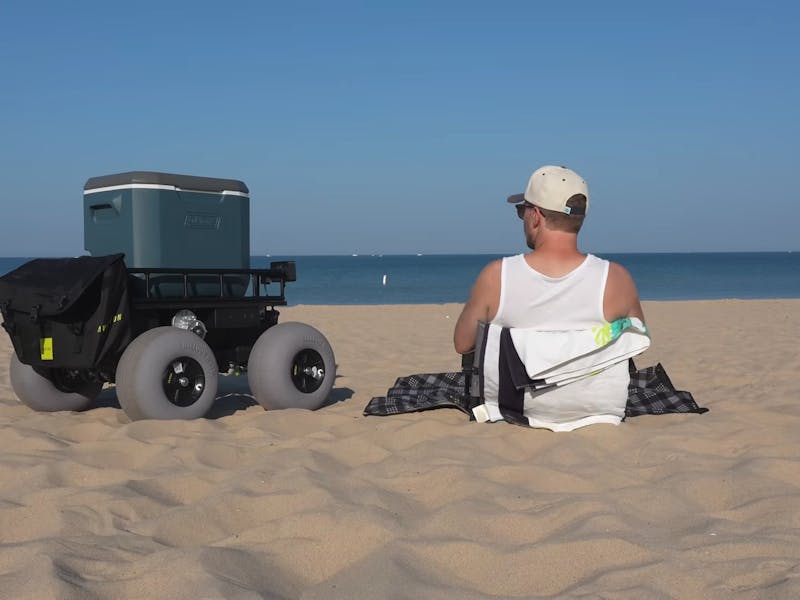
Want a robot that carries your cooler, umbrella, and towels across soft sand while you walk empty-handed? Here’s the parts pile you’d gather first: an e-bike cargo rack for the frame, two 350-watt geared DC motors, a pair of 12V sealed lead-acid batteries, wide balloon tires, an ESP32, and a fistful of bicycle chain and sprockets. That’s the shopping list behind John Boss’s beach-hauling cart, and none of it is exotic.
What Boss actually built
Living near Lake Michigan, Boss got tired of dragging gear across sand that turns every trip into leg day. He bolted a 3/4-inch plywood deck onto the cargo rack, then raised the drivetrain on wooden standoffs so the batteries and motors could tuck underneath. Each rear wheel gets its own motor, driven through standard bicycle chains and sprockets. Because the two motors run independently, the cart steers like a tank: spin them in opposite directions and it pivots in place. The fat, low-pressure balloon tires float over sand instead of digging in.
The electronics that make it drive
The two batteries wire in series for a 24-volt system. A DC-DC buck converter drops that to 5 volts for an ESP32, which spins up its own Wi-Fi access point and serves a web page. Pull it up on your phone and you get an on-screen joystick for one-handed driving, plus a toggle for the LED headlights, no app install needed. Time-of-flight distance sensors on the front bumper watch for obstacles and cut the motors if someone steps in front. A heavy-duty relay carries the big motor current instead of running it through the dashboard switch, and an inline fuse guards the whole system. Boss also chased down a grounding fault that kept the motor controllers from responding, a classic gotcha worth checking your common ground for first if your own build acts dead.
Worth a weekend?
The skid-steer trick and the ESP32 web-joystick pattern port straight to smaller robots, so this is a solid template even if you never touch a beach. Start with a cheap ESP32 dev board and two geared motors on a breadboard, get the web joystick talking, then scale up the frame. Full build notes and photos are on the Hackster writeup. Grab an ESP32 and a motor driver at circuit.rocks and you can prototype the control side this weekend.
Frequently Asked Questions
How does the robot steer without a steering system?
It uses skid-steer. Each rear wheel has its own 350-watt motor, and driving them independently (even in opposite directions) lets the cart turn in place like a tank, so there is no separate steering mechanism.
What controls the robot and how do you drive it?
An ESP32 running off 5 volts hosts its own Wi-Fi access point and serves a web page with an on-screen joystick. You connect with a phone, no app needed, and it also toggles the LED headlights while time-of-flight sensors stop the motors near obstacles.
What will I learn if I build this?
You’ll practice motor driving and skid-steer control, powering logic from a 24V pack through a buck converter, hosting a web control interface on an ESP32 access point, and reading time-of-flight sensors for obstacle safety, skills that transfer to any wheeled robot project.
