
What you would need
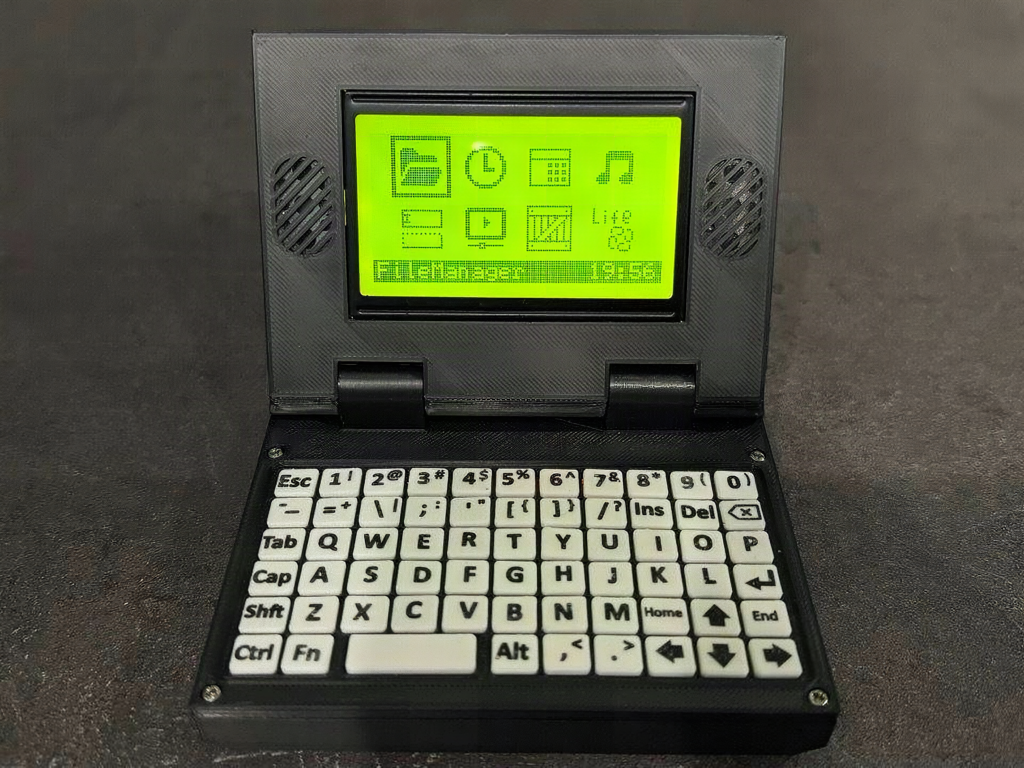
Start with an ATmega2560 board (a Mega 2560 Pro Mini keeps it small), a 128 x 64 ST7920 monochrome LCD, a VS1053 audio decoder, a microSD slot, an RTC module, one 18650 cell, and 64 tactile switches for the keyboard. The enclosure in the original build measures 12 x 11 x 3.4 cm, so plan your board layout before you order anything. For a thesis or capstone, this parts list also doubles as a tidy bill of materials.
What Vladimir built
AVR-Laptop is a pocket computer that multitasks on an 8-bit chip. You can start a video, Alt+Tab into Sokoban, and the audio keeps playing. The apps include a file manager, music player, clock, calculator, Snake, Game of Life, and a text editor. Each app is a class with setup and loop methods, so writing a new one feels like writing an Arduino sketch. The full write-up is linked from the Hackster news page.
Technical details that matter
The tricky part is memory. The ATmega2560 has only 8 KB of SRAM, and about half is gone before any app starts. The 128 x 64 framebuffer alone takes 1 KB, and FreeRTOS, the SD buffer, and the video player take more. That is why each app has to be small and why the shell handles stack allocation for you.
Video runs at 24 frames per second or more by skipping conventional codecs. Frames are stored as monochrome XBM images alongside MP3 audio, so the VS1053 decodes sound while the AVR only pushes pixels to the LCD. The keyboard started as an 8 x 8 matrix. A later revision added a diode per key and a 4-to-16 decoder, which frees GPIO pins and fixes ghosting when you hold several keys.
Wrap-up
Copy the diode-per-key matrix trick even if you never build the laptop: it works on any keypad project where pins run short. If you want to practise on a smaller step first, wire an ST7920 to a Mega 2560 on a breadboard and draw one XBM bitmap. Mega-class boards and small displays are stocked at circuit.rocks.
Frequently Asked Questions
What does AVR-Laptop use to play video?
A VS1053 chip decodes MP3 audio while the ATmega2560 streams monochrome XBM frames to a 128 x 64 ST7920 LCD, reaching about 24 frames per second.
What parts and skills does this build need?
You need a Mega 2560 board, an ST7920 LCD, a VS1053, a microSD slot, an RTC, an 18650 cell, and 64 key switches. Soldering, C++, and patience with tight memory budgets are the main skills.
What will I learn if I build this?
You will learn how an RTOS schedules tasks, how to budget 8 KB of SRAM, how keyboard matrices and decoders save GPIO pins, and how to structure apps as classes with setup and loop methods.
