
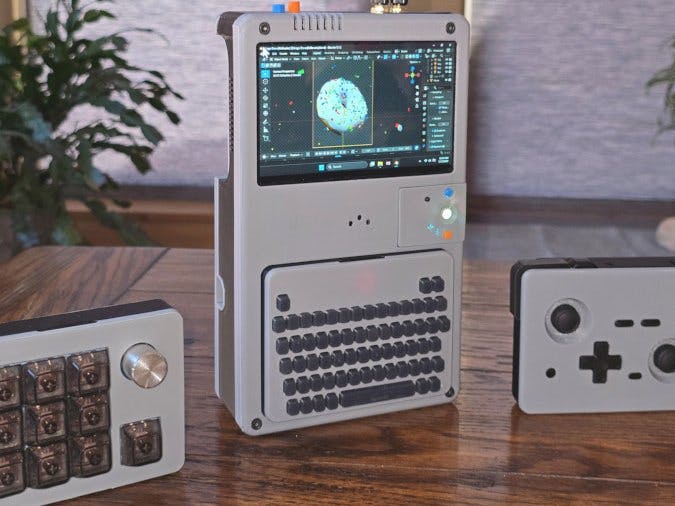
Clear your bench for a weekend and you could have a pocket-sized PC that dual-boots Windows and Linux. That is the promise behind the CG Deck, a modular handheld from two-person startup Mogozen that just hit its final prototype before crowdfunding. The hardware files are heading to GitHub, so this is a build you can eventually wire together yourself.
What Mogozen actually built
The CG Deck is built around the LattePanda IOTA, an Intel N150 single-board computer with up to 16GB of RAM, 128GB of eMMC storage, and an onboard RP2040 coprocessor. Running x86 (AMD64) instead of an Arm chip means it boots standard Windows or Linux with normal UEFI firmware, no custom images required. The shell measures 7.4 x 4.6 x 2.25 inches and carries a 5-inch capacitive touch display, Wi-Fi 7, and Bluetooth.
The modular trick
Two accessory slots let you swap controls without resoldering anything: a gamepad, a 64-key compact keyboard, a Creator module with a 10-key macro pad and rotary knob, or a trackpad. Inside sits an M.2 NVMe slot and an optional 4G module, with a planned PCIe expansion port for hooking up an external GPU. The RP2040 handles the low-level button and sensor duties while the Intel chip does the heavy lifting.
Parts and cost reality
This is not a cheap Saturday. The LattePanda IOTA board alone is the priciest piece, and you still need NVMe storage, a battery, the 5-inch panel, and the printed shell before you pick up a soldering iron. The tricky part is sourcing the IOTA and the display connectors, since everything else is off-the-shelf maker stock. Mogozen plans to release the design files under a Creative Commons BY-NC-ND 4.0 license once the Kickstarter funds.
Spend a Sunday planning it
Watch for the CG Deck repo on GitHub, sign up on the Mogozen site for the campaign launch, and sketch your own module layout while you wait. Read the full write-up on Hackster. If you have wanted a handheld that grows with your projects instead of one you replace every year, this is the weekend rabbit hole to fall into.
Frequently Asked Questions
What computer powers the Mogozen CG Deck?
It runs the LattePanda IOTA, an Intel N150 single-board computer with up to 16GB of RAM, 128GB of eMMC, and an RP2040 coprocessor. The x86 architecture lets it boot standard Windows or Linux.
Can I build the CG Deck myself?
Mogozen plans to publish the hardware files on GitHub under a Creative Commons BY-NC-ND 4.0 license after its Kickstarter funds. You would source the LattePanda IOTA, NVMe storage, a 5-inch display, a battery, and print the modular shell.
What will I learn if I build this?
You will get hands-on with x86 versus Arm single-board computers, UEFI firmware, M.2 NVMe storage, and modular hardware design, plus the wiring and integration skills to turn a bare board into a finished handheld.
