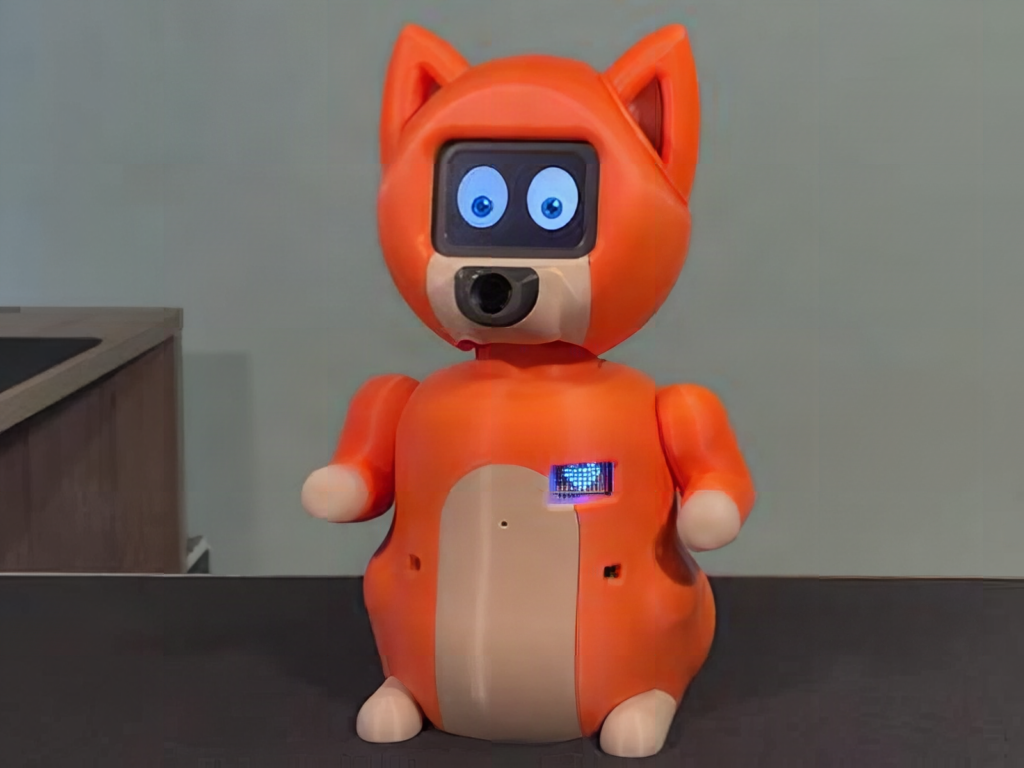
Boards that pack a Linux-capable processor next to a real-time microcontroller on one PCB are changing what a weekend robot project can do — you get AI-grade processing and precise motor timing without wiring two separate boards together. The Arduino UNO Q is one of the newest of these hybrid boards, and maker Luca Di Lorenzo used one to build Nuvi, a desk companion shaped like a Shiba Inu that talks, dances, and reads hand gestures.
A Shiba Inu on Your Desk
Nuvi stands under 12 inches tall, with a custom 3D-printed shell hiding most of the hardware. It moves its head, arms, and ears, responds to touch, and shows animated expressions on a 4-inch LCD face. Di Lorenzo says fitting two serial servos into the neck without exposed wiring was the tricky part of the build; he went through several housing iterations before the mechanism stayed fully hidden inside the body.
What’s Actually Running Inside
The UNO Q’s quad-core Linux side handles AI and voice processing, while its microcontroller side manages the time-sensitive work: driving four metal-gear servos over I2C through a PWM driver, and polling onboard sensors without dropping a frame of motion. Nuvi uses:
- Distance sensors, so it powers down when no one is in the room
- Capacitive sensors in the head and belly to detect petting
- A temperature and humidity sensor for basic room reporting
- A noise-filtering microphone, muted automatically while Nuvi is talking
Voice requests get routed to Gemini for responses, while Piper runs locally on the board for offline text-to-speech — no cloud round-trip needed just to hear Nuvi reply. An open-hand gesture triggers an environment report; a V-sign can toggle smart lighting, all through onboard computer vision rather than a phone app. Splitting those jobs across two processor types on one board is exactly the pattern worth studying if you’re planning your own AI-plus-motors project.
Try This on Your Own Bench
Di Lorenzo published the 3D design files, bill of materials, source code, and build instructions on the project’s Hackster page, and none of it is locked to the Shiba Inu shape. Swap the enclosure and the same UNO Q plus servo-and-sensor stack could drive a different desk creature entirely — a solid capstone build for anyone who wants hands-on practice splitting AI workloads from real-time motor control on a single board.
Frequently Asked Questions
What board powers Nuvi, and why does it matter for a robot like this?
The Arduino UNO Q, which combines a quad-core Linux-capable processor with a microcontroller on one board. The Linux side runs AI and voice processing (Gemini for responses, Piper for offline text-to-speech) while the microcontroller handles real-time servo and sensor timing over I2C and PWM.
What parts does Nuvi use to move and sense its surroundings?
Four metal-gear servos driven over I2C through a PWM driver move the arms and ears, two additional serial servos give the head extra motion, a 4-inch LCD shows expressions, and distance, capacitive, and temperature/humidity sensors plus a noise-filtering microphone handle input.
What will I learn if I build something like Nuvi?
Hands-on practice splitting workloads between a Linux processor and a microcontroller, wiring and driving servos over I2C/PWM, integrating a cloud AI API with local offline processing, and packaging electronics into a 3D-printed enclosure. These map directly onto ECE capstone and robotics-competition builds.
