
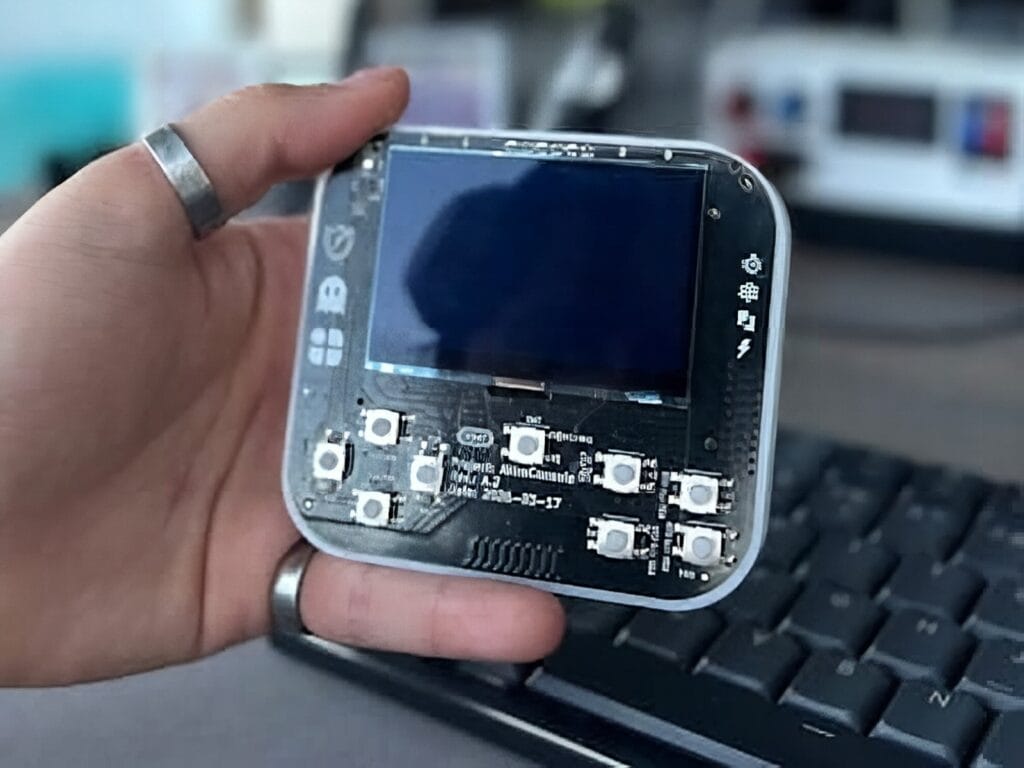
Imagine pocketing a single gadget that can sniff Wi-Fi, replay sub-gigahertz signals, run NFC experiments, and still play 8-bit games on the bus ride home. That is exactly the pitch behind the AkiraConsole, a new ESP32-powered handheld out of Moldova that is gearing up for a crowdfunding launch.
Designed by pen.engineering, the AkiraConsole is aimed at hardware hackers, network security researchers, makers, and curious tinkerers who want a portable RF lab that doubles as a retro console. It is built around Espressif’s well-known ESP32-S3 platform and runs a custom firmware stack called AkiraOS, which is layered on top of the Zephyr real-time operating system. Apps for the device are written in WebAssembly, which makes it relatively easy for the community to drop in new tools or games without rebuilding the whole firmware.
What’s inside
The brains of the AkiraConsole is an ESP32-S3-WROOM-1 module, providing 2.4 GHz Wi-Fi and Bluetooth 5 Low Energy. To extend its range and frequency coverage, the board pairs that module with a Semtech LR2021 LoRa transceiver and a Texas Instruments CC1101 sub-GHz radio, both wired to antennas tuned for 868/915 MHz and 2.4 GHz. An STMicroelectronics ST25DV dynamic NFC tag handles Universal Second Factor (U2F) workflows and tap-to-pair tricks, while a 6-axis LSM6DS3S IMU adds motion sensing for gaming and gesture experiments.
On the outside, you get a 2.8-inch full-color IPS LCD, a tactile four-way D-pad with four fire buttons, a buzzer for audio cues, microSD storage, and a USB Type-C port. Expansion is taken seriously too: there are SPI, I2C, I2S, USB, and GPIO pins broken out, plus a proprietary cartridge slot for future add-on boards. A JST PH header lets you bolt on a lithium-polymer battery for truly portable use.
Build it yourself
You can prototype a stripped-down version of this concept on the bench today. Grab an ESP32-S3 dev board, a 2.8-inch IPS LCD, an LSM6DS3 6-axis IMU breakout, a microSD module, a small piezo buzzer, and a USB Type-C breakout. For RF experiments, add a CC1101 sub-GHz module and, if you want long-range LoRa, an LR2021-based board. Throw in a JST PH lithium-polymer cell and you have the bones of your own pocket-sized hacking and gaming rig.
The AkiraOS source code is already on GitHub under the Apache 2.0 license, and pen.engineering plans to release the hardware files after backers receive their units.
Frequently Asked Questions
What chip powers the AkiraConsole?
It is built around an Espressif ESP32-S3-WROOM-1 module, which provides 2.4 GHz Wi-Fi and Bluetooth 5 Low Energy. AkiraOS, layered on top of the Zephyr RTOS, runs WebAssembly apps on that ESP32-S3 hardware.
Which radios does the AkiraConsole use for sub-GHz and LoRa work?
Alongside the ESP32-S3‘s built-in Wi-Fi and BLE, the AkiraConsole adds a Semtech LR2021 LoRa transceiver and a Texas Instruments CC1101 sub-GHz radio, paired with antennas tuned for 868/915 MHz and 2.4 GHz operation.
What will I learn if I build this?
You will get hands-on practice wiring an ESP32-S3 to multiple radios over SPI, driving an IPS LCD, reading a 6-axis IMU, and managing power from a lithium-polymer battery. You will also learn how to organize firmware around an RTOS like Zephyr and how to package small WebAssembly apps for embedded targets.
