
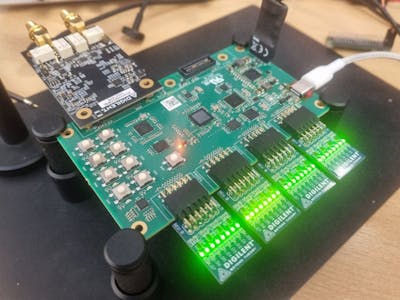
Want to design real microchip-style logic at home without a five-figure toolchain? Here is what you would need to get started with the new Adiuvo Explorer Board: the $99 board itself, a single USB-C cable, and AMD’s free-tier Vivado tools running on a modest laptop. That is genuinely it — no bench power supply, no separate JTAG programmer, no add-on debugger. For an ECE student or a school robotics team, that shopping list is the whole point.
What the Explorer Board actually is
FPGAs let you build custom digital circuits in reconfigurable hardware — the closest most makers will ever get to rolling their own silicon. The Explorer Board is an open-source platform built around the AMD Artix UltraScale+ AU7P FPGA, aimed squarely at learners who have been priced out of serious FPGA hardware. It is pitched as a board you can grow with: gentle enough for a first Verilog blink, capable enough for a capstone project that talks to real high-speed peripherals.
The specs that matter
Under the hood you get 82,000 system logic cells, 216 DSP slices, and 3.8 Mb of block RAM — plenty for signal processing, soft CPU cores, or parallel sensor pipelines. Power, programming, and serial communication all share one USB-C connector, with an onboard FTDI chip handling JTAG and UART. Four standard Pmod headers let you bolt on sensors, displays, and motor drivers, while high-speed Zmod and SYZYGY interfaces plus four GTH transceivers push up to 12.5 Gbps for the ambitious. Clever engineering keeps it cheap: the designers route a fine-pitch BGA using ordinary PCB fabrication through an offset through-hole via trick, so the board does not need exotic manufacturing.
Why it belongs on your bench
The whole project is open source — schematics, PCB layouts, and reference designs are being published, so you can study exactly how a modern FPGA board is built or fork it for your own design. That transparency turns the Explorer Board into a teaching tool as much as a dev board. If you have been curious about FPGAs but scared off by the cost, this is one of the friendlier on-ramps we have seen.
Frequently Asked Questions
Which FPGA does the Adiuvo Explorer Board use?
It is built around the AMD Artix UltraScale+ AU7P, offering 82,000 logic cells, 216 DSP slices, 3.8 Mb of block RAM, and four GTH transceivers rated up to 12.5 Gbps.
What do I need to start, and what does it cost?
Just the $99 board and a USB-C cable. Power, programming, and UART all run over that single connection, and AMD’s free Vivado tier handles the software, so there are no hidden hardware costs.
What will I learn if I build with this?
You will pick up FPGA fundamentals — writing Verilog or VHDL, synthesizing and constraining designs, and driving real peripherals over Pmod. Because the board is open source, you can also study its schematic and PCB layout to understand how high-density digital hardware is actually engineered.
