
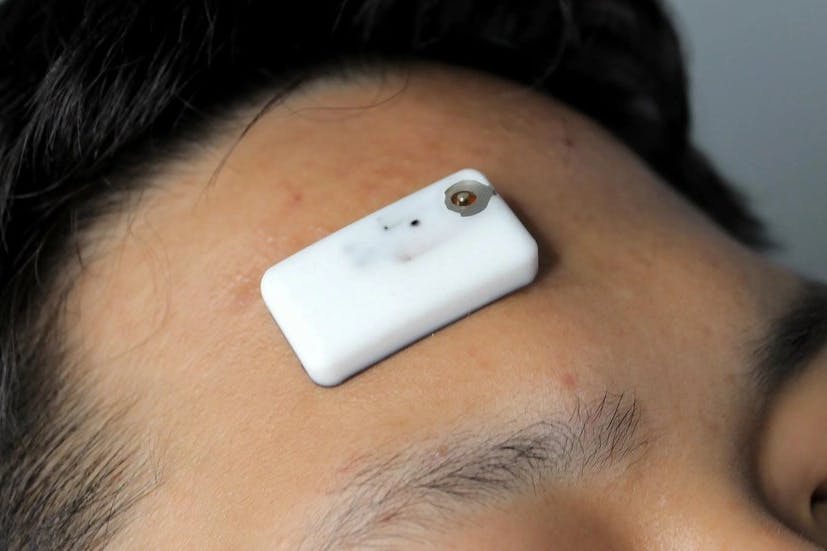
It is 2 a.m. and your brain is doing housework. While you sleep, a plumbing network called the glymphatic system flushes out the metabolic junk your neurons pile up all day. Scientists suspect this nightly rinse helps hold off diseases like Alzheimer’s, but catching it in the act usually meant strapping someone into a noisy MRI tube for one awkward lab night. A team from Georgia Tech and Seoul National University wanted to watch it happen in a real bed, so they shrank the whole idea down to something that sticks to your forehead like a Band-Aid.
What they built
The patch is under a centimeter thick, wrapped in soft silicone so it stays put without pinching. It runs wirelessly off a rechargeable cell, so there are no dangling wires to yank a sleeper awake. Instead of imaging cerebrospinal fluid directly, it infers movement: if the water content in brain tissue climbs while blood volume stays flat, that hints the glymphatic system is carrying waste away. One quiet sticker doing the job of a room-sized scanner.
How they pulled it off
The trick is near-infrared spectroscopy. Three wavelengths of light shine into the forehead: two track oxygenated and deoxygenated hemoglobin, and the third is soaked up mostly by water. A multispectral photodetector reads how much light scatters back, and the math turns that into a total-water estimate. The guts are flexible printed circuits carrying the LED array, that photodetector, a Bluetooth Low Energy radio, and a 110 mAh LiPo battery. Running flat out, the prototype sips 70 to 75 milliwatts and lasts about 5.5 hours per charge. Mechanical simulations showed the flex PCB stays under its stress limit even when bent, which matters when it lives on a face that rolls into a pillow.
Why a maker should care
You do not need a research grant to play in this space. A hobby NIRS or pulse-oximetry rig starts with an LED, a photodiode, and an I2C sensor breakout on a breadboard, and BLE modules like the ESP32 or an nRF52 give you the wireless link for a few hundred pesos. The hard part is not the parts count, it is the signal: ambient light leakage, skin tone, and motion all muddy the reading, so you spend real time on filtering and calibration. Read the full Hackster write-up for the design details, then try logging a single-channel photodiode against your own heartbeat before you chase three wavelengths.
Frequently Asked Questions
How does the patch measure brain fluid without an MRI?
It uses near-infrared spectroscopy, shining three wavelengths into the forehead. Two track oxygenated and deoxygenated hemoglobin and the third is absorbed by water, so a photodetector reading of scattered light estimates changes in total brain water.
What powers the device and how long does it run?
A rechargeable 110 mAh LiPo battery on flexible printed circuits. The prototype draws about 70 to 75 milliwatts and runs roughly 5.5 hours per charge, sending data over Bluetooth Low Energy.
What will I learn if I build a project like this?
You will pick up optical sensing with LEDs and photodiodes, I2C sensor wiring on a breadboard, BLE data links with an ESP32 or nRF52, and the real skill here: filtering noisy biosignals against ambient light, motion, and skin-tone variation.
