
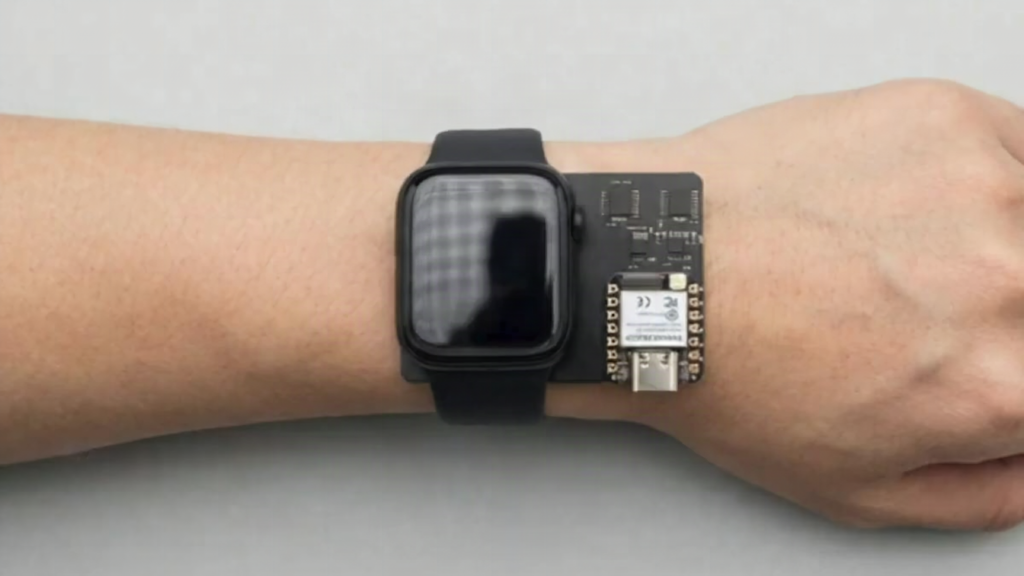
Wearable input is moving off the touchscreen. Camera tracking and EMG armbands have had their turn; the trend worth watching in 2026 is sensing that hides inside hardware you already wear. EITWatch, a research prototype from Northwestern University, is a good example: it reads hand gestures from the back of an ordinary 40 mm smartwatch case using electrical impedance tomography (EIT), a technique borrowed from hospital lung imaging and shrunk to a ring of electrodes.
What the Northwestern team built
The sensing head is a custom PCB with eight gold-plated electrodes laid out in a 31 mm diameter ring, small enough to sit under a standard watch body against the skin. The board passes tiny alternating currents between electrode pairs and measures how the signal travels through tendons and muscle. Make a fist and the impedance map of your wrist changes; pinch, and it changes differently. A Seeed Studio XIAO ESP32-S3 runs the whole measurement loop at 48 frames per second and ships the data off for classification. The electronics still spill outside the housing in this prototype, but the electrode area fits entirely inside the watch footprint.
Testing used 12 participants and two gesture sets: six large poses (fist, point, thumbs-up and friends) and five fine movements such as a pinch or a thumb slide across the index finger. Within a single wearing session the classifier hit 91.4% accuracy on the large set and 90.1% on the small one. Take the watch off, put it back on 48 hours later, and those numbers drop to 73.2% and 70.4%. Cross-user accuracy (training on one person, testing on another) was lower still.
The technical takeaway: multi-depth scanning
Classic EIT drives current between adjacent electrodes and reads voltage on the rest. EITWatch adds multi-depth scanning: it varies the spacing between the driving pair, so some current paths hug the skin while others cut deeper through the forearm tendons. Stacking those paths gives the model a crude 3D view instead of a surface map. The gotcha for anyone cloning this is the analog front end. You need a stable AC excitation source, a precision current sense, and a fast ADC path, and the ESP32-S3‘s internal 12-bit ADC is noisy enough that an external AFE (an AD5933 impedance converter is the usual hobbyist shortcut) is the realistic route. Contact pressure and skin moisture explain the re-wear accuracy sag.
What to try next
A full EIT ring is a thesis-scale build, but the pieces scale down nicely for a capstone or robotics-club project. Start with a XIAO ESP32-S3 (about PHP 500 at circuit.rocks) and a single AD5933 on the I2C bus (SDA on D4, SCL on D5) with two stainless snap electrodes, and log wrist impedance to serial while you open and close your hand. Once you can see the fist/relax difference on a plot, add electrodes and move to a small on-device classifier with TensorFlow Lite Micro. Read the original write-up at Hackster for the paper figures and hardware block diagram before you pick your electrode layout.
Frequently Asked Questions
How does EITWatch detect gestures without a camera or touchscreen?
It uses electrical impedance tomography: eight electrodes on the back of the watch pass small alternating currents through the wrist and measure how tendon and muscle movement changes the tissue impedance. A classifier maps those impedance patterns to gestures such as a fist, a pinch, or a thumbs-up.
How accurate is it, and what are its limits?
In a single wearing session it reached 91.4% on six large hand poses and 90.1% on five fine finger movements across 12 participants. Accuracy fell to roughly 70-73% after the watch was removed and re-worn 48 hours later, and dropped further for users whose data was not in the training set, so electrode contact and per-user calibration remain open problems.
What will I learn if I build a simplified version of this?
You will practice analog front-end design (AC excitation, current sensing, ADC noise), I2C communication between an ESP32-S3 and an impedance converter like the AD5933, time-series data logging, and training a small gesture classifier that runs on a microcontroller. It touches biomedical sensing, embedded firmware, and edge machine learning in one project, which makes it a strong ECE thesis or capstone topic.
