
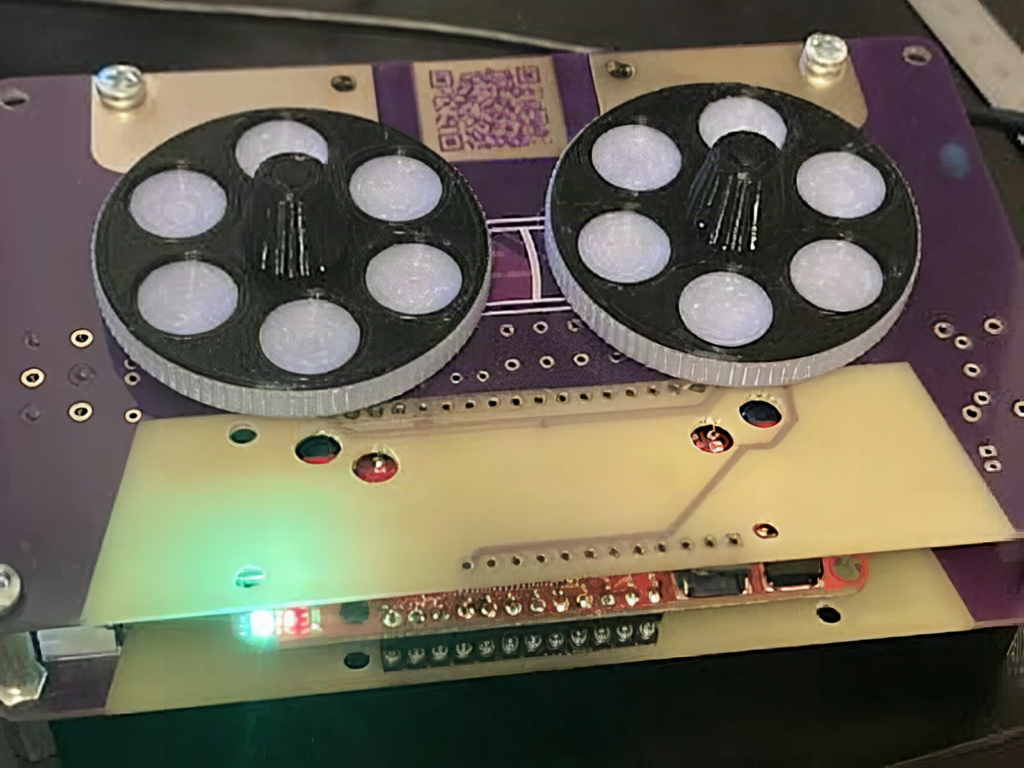
A tape deck lets you grab the reel and hunt for a spot by hand. Most digital players give you a thin progress bar instead. Maker Mykle decided a weekend-style hack could fix that, and the result is TWEACMAN, a pocket WAV player with two knobs that scrub audio like a virtual tape head.
What got built
TWEACMAN plays WAV files from an SD card at speeds from 0.001x to 1000x, forward or backward. Turn a knob and the playback position moves with it, much like rocking a reel against the head. Capacitive touch pads add two more controls, and a Bluetooth LE module handles wireless control. The styling nods to TEAC decks and the Sony Walkman.
Parts and the one gotcha
The brain is a SparkFun Thing Plus RA6M5, built around the Renesas RA6M5 microcontroller. It has six 12-bit ADC channels, a floating-point unit, two output amplifiers that give stereo audio without a separate DAC, and a battery charger for a 3.7 V LiPo cell. That is most of the bill of materials in one board.
The tricky part is the knobs. Instead of rotary encoders, Mykle used two Taiwan Alpha RV112-FF dual 360-degree potentiometers. Each one hides two pots mounted 90 degrees out of phase, so each knob eats two ADC channels (four of the six total). Read both voltages, run an atan2 calculation, and you get an absolute shaft angle that keeps spinning in either direction. Calibration matters because every part has slightly different end-point voltages, and the Arduino library Mykle wrote handles that plus multi-turn counting.
Spend your Sunday on this
You do not need the full player to learn from it. Start with the prototype stage: wire one dual pot to two analog pins, print the raw readings, and plot the sine and cosine curves in the Serial Plotter. Once you see the 90 degree offset, the angle math clicks. Then drive two oscillators from the angles, which is the demo Mykle used to show off the resolution.
For ECE thesis builds, this is a cheap alternative to optical encoders when you need smooth, continuous input, such as a gimbal dial or a CNC jog wheel. Grab the code and the Arduino libraries from the original write-up at Hackster, then try swapping the potentiometers for a pair of ordinary linear pots to see why the quadrature trick is needed.
Frequently Asked Questions
How does TWEACMAN read knob position without encoders?
Each Taiwan Alpha RV112-FF contains two potentiometers 90 degrees out of phase. Reading both analog voltages and applying trigonometry gives an absolute angle, and the knob can spin continuously in either direction.
What hardware does the TWEACMAN prototype need?
A SparkFun Thing Plus RA6M5 board, two RV112-FF dual potentiometers, an audio jack, an SD card, and a 3.7 V LiPo battery. The board’s built-in amplifiers produce stereo audio without an external DAC.
What will I learn if I build this?
You practice reading analog inputs with a 12-bit ADC, calibrating sensors, doing atan2 angle math, tracking multi-turn rotation in code, and playing WAV files from an SD card with Arduino libraries.
