
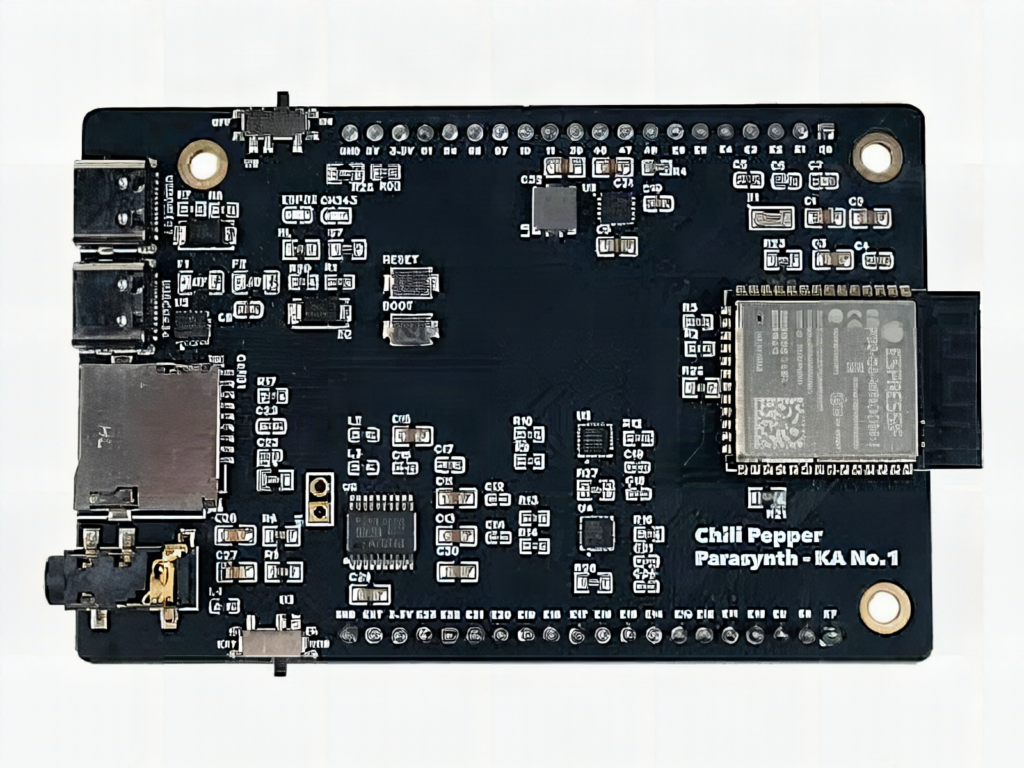
Before you build a DIY synth on an ESP32-S3, line up the parts: an audio DAC, a touch controller, a microSD slot, a USB port that speaks MIDI, and a power circuit that survives a battery. Chili Pepper, an open source board from Korallum Atelier No.1, puts all of that on one PCB so the shopping list shrinks to a single item.
What is on the board
The brain is an ESP32-S3 with 16 MB of flash and 8 MB of PSRAM, enough headroom for samplers and grooveboxes that keep audio buffers in RAM. Two MPR121 chips give 24 capacitive touch inputs, so pads and keys need no switches. A PCM5102 DAC outputs stereo, 32-bit, line-level audio, and a microSD slot holds your samples. The Hackster writeup has the full spec list.
The technical details that matter
The board measures 93.3 x 59 mm and exposes 10 spare GPIOs for knobs, an OLED or extra sensors. A buck-boost converter accepts 1.8 V to 5.5 V, so a single lithium cell or two AA batteries can run a portable instrument. Native USB MIDI means the ESP32-S3 shows up as a class-compliant device in a DAW with no driver, while a separate CH343 chip handles serial flashing. Wi-Fi and BLE add wireless MIDI as an option.
The gotcha with I2C touch chips is address clashes: both MPR121 units sit on the same SDA and SCL lines, so check which address pins are tied high before you add a third device to the expansion header.
Build it yourself
The board is heading to crowdfunding with no price or date yet, so prototype the idea now. Wire an ESP32-S3 dev board to an MPR121 breakout over I2C and a PCM5102 module over I2S, then play a sine wave per pad using the Arduino audio libraries. Once that works, moving to Chili Pepper is mostly a pin remap. Firmware is Apache 2.0 and hardware is CERN-OHL-S-2.0, so you can fork both.
- Pull unused touch electrodes to ground to stop phantom notes.
- Keep I2S clock lines short, under about 10 cm on a breadboard.
- Browse ESP32 boards and breakout modules at circuit.rocks.
Frequently Asked Questions
What chips does the Chili Pepper board use?
An ESP32-S3 with 16 MB flash and 8 MB PSRAM, two MPR121 touch controllers for 24 inputs, a PCM5102 stereo DAC, and a CH343 USB-to-serial chip.
Can I run Chili Pepper on batteries?
Yes. Its buck-boost power circuit accepts 1.8 V to 5.5 V, so a single lithium cell or a pair of AA batteries can power a portable instrument.
What will I learn if I build this?
A prototype teaches I2C touch sensing, I2S digital audio output, USB MIDI on the ESP32-S3 and sample playback from microSD, a strong set of skills for a sound or instrument thesis.
