
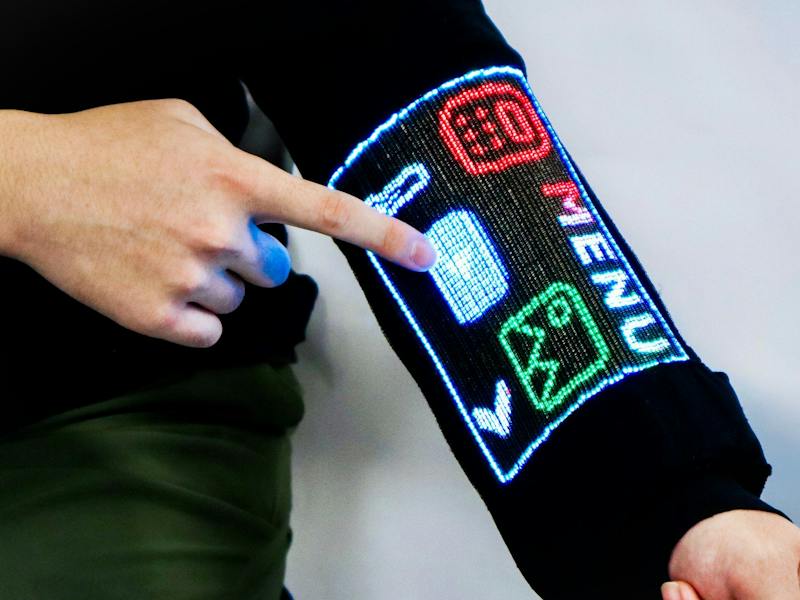
A sweater sleeve that plays video and reads your body temperature sounds like a gimmick until you check the numbers: 96 x 54 pixels, 8-bit color, 30 frames per second, and it survived 50 trips through a washing machine. Researchers at the National University of Singapore built it from LED fibers, as covered in the Hackster write-up.
What the team made
The group led by Assistant Professor Tural Khudiyev wove 54 fibers into a sleeve panel measuring 168 x 105 mm. Each fiber is only 1 mm thick, carries 96 individually addressable LEDs, and has a touch-sensing layer underneath. Press a spot and the circuit closes, so the controller knows which pixel you hit and can light it. Each fiber has its own control channel, which means one broken thread does not black out the whole display. Extra fibers add a microphone, speaker, magnetometer, motion and light sensors, plus a temperature sensor under the arm.
The tricky part: wiring a one-dimensional board
A normal PCB has two dimensions to route traces. A fiber has almost none, so the team used a laser to expose tiny spots on insulated wire, then let controlled surface wetting pull molten solder onto only those spots. That process joined more than 5,000 chips with over 20,000 connections. The LED strings are then thermally drawn into a multilayer fiber up to 10 meters long. After 1,000 bends around a 5 mm radius, light output and touch response barely changed.
Build it yourself, at breadboard scale
You can copy the idea without a cleanroom. Take an 8×8 WS2812B matrix, an ESP32, and a few strips of conductive tape or copper foil as a crude touch layer. Wire the data line to GPIO 5, read the foil pads with the touchRead() function in the Arduino core, and light the LED nearest the pad you press. Add a 330 ohm resistor on the data line and a 1000 uF capacitor across the 5 V rail so the LEDs do not glitch at startup. For a thesis or capstone, a washable wearable is a good test of strain relief and soldering quality, and a plain 8×8 matrix plus an ESP32 from circuit.rocks keeps the first prototype cheap. Specs and photos are on the source page.
Frequently Asked Questions
How does the fiber touchscreen detect touch?
Each 1 mm fiber has a sensing layer beneath its LEDs. Pressing the fiber completes a circuit, and the controller reads which fiber and position was pressed, then lights the matching pixel.
How many LEDs and fibers does the sleeve prototype use?
The NUS prototype weaves 54 fibers with 96 LEDs each into a 168 x 105 mm display at 96 x 54 pixels, 8-bit color and 30 frames per second.
What will I learn if I build this?
A breadboard version teaches addressable LED control, capacitive touch reading on ESP32 GPIO pins, power decoupling, and wearable strain relief, all useful for thesis and capstone projects.
