
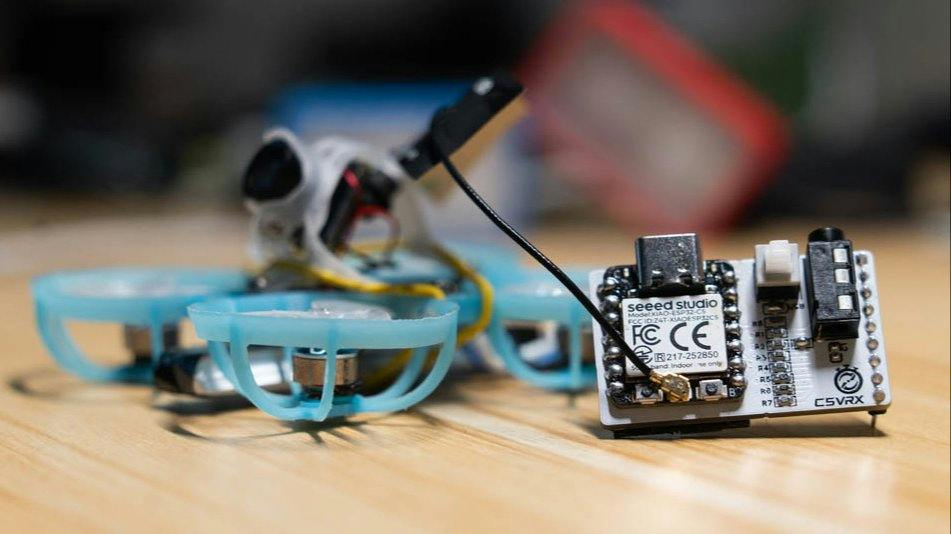
Cheap microcontrollers keep eating jobs that used to need dedicated radio chips. Wi-Fi radios are now doing software-defined radio tricks, and the newest example is C5VRX-5, an open source project by a hacker named Leon that, as Hackster.io reported, turns a Seeed Studio XIAO ESP32-C5 into a 5.8 GHz analog FPV video receiver.
The build itself
FPV drone pilots watch a live camera feed over analog video on the 5.8 GHz band, and a receiver normally needs a specialized RF module. C5VRX-5 skips that module. The ESP32-C5’s own Wi-Fi radio picks up the signal, and custom firmware recovers the picture. The only extra parts are seven resistors: six form a passive 6-bit DAC on GPIO pins D4 to D9, and one more sets the output load. The result is composite video that plugs into FPV goggles, a monitor, or a recorder, in either PAL or NTSC.
Technical takeaway
The gotcha with this kind of hack is speed. The firmware samples selected bits from the radio’s ADC at 40 million samples per second, using a pipeline that keeps the CPU out of the sample path. On top of that sit a demodulation algorithm called U85Q with a 32-phase tracker, automatic gain control, and AFC to keep the carrier centered when a transmitter drifts. The project supports 48 channels and installs through a browser-based flasher, so you do not need a toolchain to try it. The author notes that some features are validated on hardware and others still need testing, so expect rough edges.
What to try next
If you teach electronics or run a robotics club, the 6-bit resistor DAC is the part to copy first. Wire six resistors from D4 to D9 into a summing node, read the output on a scope, and watch a digital counter turn into a staircase waveform. It is a fast way to show students how a DAC works with nothing but a breadboard. For the full RF build, read the project’s GitHub repository linked from the Hackster write-up, and check ESP32-C5 board availability before ordering parts for a class set. Common ESP32 boards and jumper wires are stocked at circuit.rocks.
Frequently Asked Questions
What hardware does C5VRX-5 need?
A Seeed Studio XIAO ESP32-C5 board and seven resistors. Six form a 6-bit DAC on pins D4 to D9, and one is the output load for composite video.
What video output does it produce and how many channels?
It outputs composite video compatible with PAL or NTSC, usable on FPV goggles, a monitor, or a recorder, and supports 48 channels. Firmware installs from a browser-based flasher.
What will I learn if I build this?
You will learn how a resistor-ladder DAC works, how ADC sampling at high rates is structured, and how gain control and carrier centering keep an analog signal stable. You also get practice flashing and testing open source firmware.
