
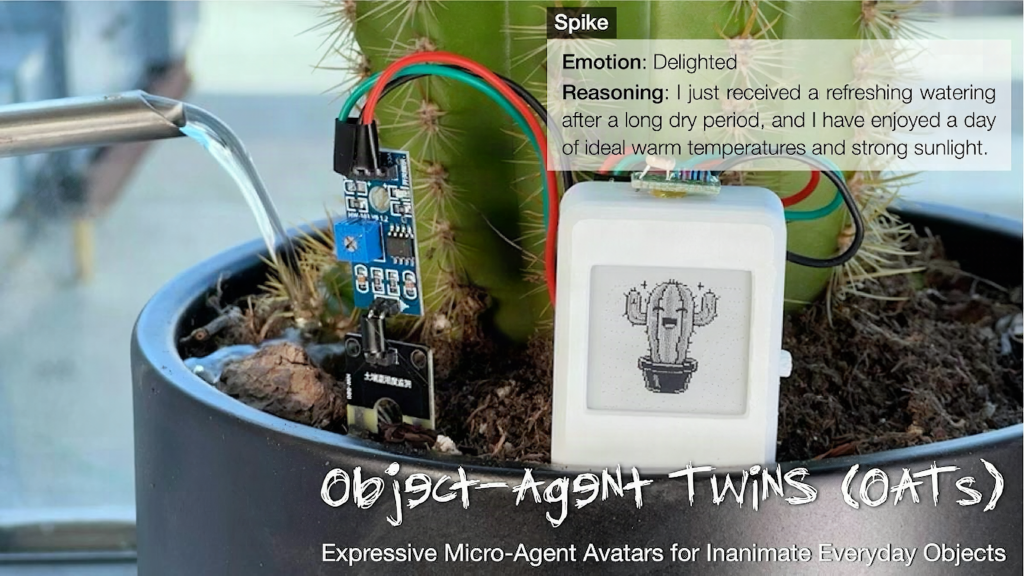
Got a free Saturday and a dying cactus on the windowsill? Carnegie Mellon researchers Daehwa Kim and Chris Harrison turned that exact problem into a weekend-sized build: a small ESP32 gadget that gives a plant, a fridge, or a skateboard a pixel-art face and a mood, as Hackster.io covered.
What did they build?
The system is called Object-Agent Twins, or OATs. Each unit clips onto an ordinary object and shows a Tamagotchi-style character on a 1.54-inch two-color E Ink screen. A thirsty cactus looks depressed, then cheers up after you water it. A skateboard looks bored in the corner and excited when you ride. The character has 12 emotional expressions, from excited to frustrated, and a person describes the object in a web form to set them up.
Parts and cost reality
The core is a Waveshare ESP32-S3 board with the E Ink panel, an SHTC3 temperature and humidity sensor on the I2C pins (SDA/SCL), and a microphone for sound level. A custom expansion board adds motion, occupancy, light, and soil moisture sensors. Power comes from a 1,100 mAh LiPo cell that lasts about a week. The team puts the whole unit under US$20, with each extra sensor under US$5, and the case is 3D-printed.
The smart part is how little the board does. It wakes every 2 seconds, reads the sensors, and runs a local anomaly check. Only when something changes enough does it send readings to a cloud server, where Google’s Gemini picks one of the 12 emotions and sends it back. That keeps the radio off most of the time, which is how a LiPo cell stretches to seven days. In their study, 12 participants set up OATs in about 15 minutes each.
Spend your Sunday on this
You do not need the cloud half to get the idea working. Wire a capacitive soil moisture sensor to an ADC pin on any ESP32 board, add a small display library for your screen, and map three moisture ranges to three faces: happy, thirsty, drowning. The gotcha is calibration: log the raw reading in dry air and in a glass of water first, then set your thresholds from those two numbers. Boards and sensors are stocked at circuit.rocks, so a classroom set of five is easy to price out.
Frequently Asked Questions
What hardware do Object-Agent Twins use?
A Waveshare ESP32-S3 board with a 1.54-inch two-color E Ink display, an SHTC3 temperature and humidity sensor, a microphone, and an expansion board for motion, light, occupancy, and soil moisture sensors.
How much does an OAT cost and how long does the battery last?
The researchers report under US$20 per unit, with optional sensors under US$5 each. A 1,100 mAh LiPo battery runs the device for roughly one week.
What will I learn if I build this?
You will practice reading I2C and analog sensors, calibrating a soil moisture probe, driving an E Ink display, sleeping the ESP32 to save battery, and mapping sensor ranges to simple states.
