
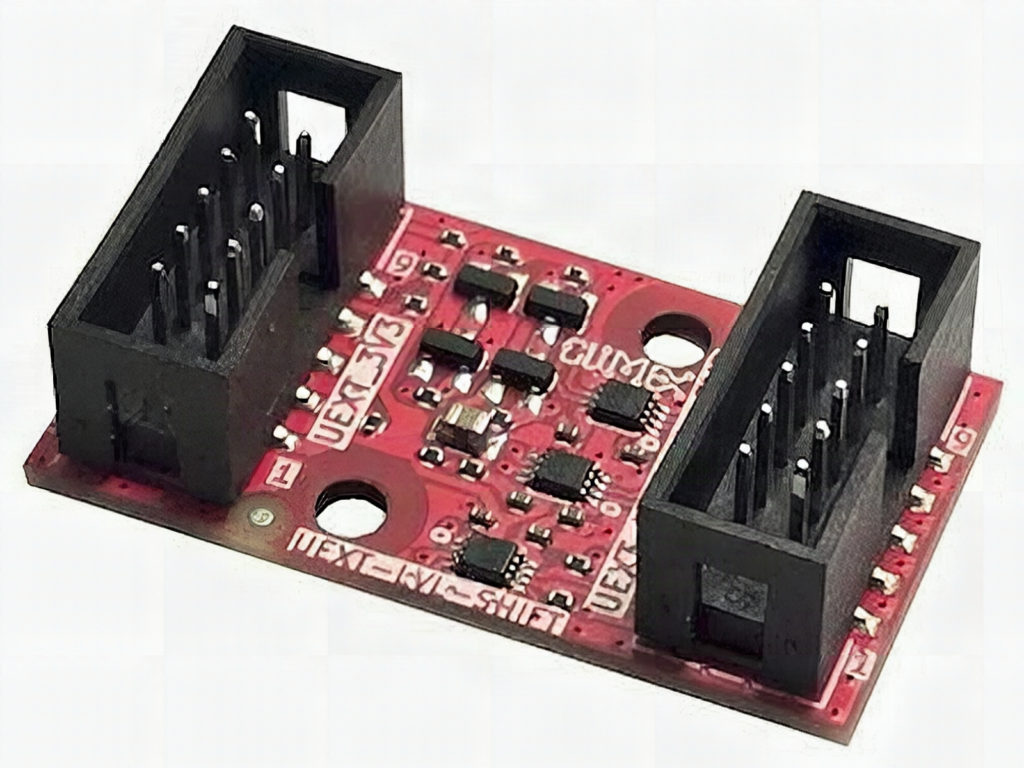
Grab a 3.3 V ESP32 or Raspberry Pi Pico, a 5 V sensor module, four jumper wires, and a breadboard. That pile is exactly where a level shifter earns its spot, and Olimex just released two new open hardware ones: the BB-LVL-SHIFT for breadboards and the UEXT-LVL-SHIFT for its UEXT connector.
What Olimex released
The BB-LVL-SHIFT is a small board that drops into a solderless breadboard, though you can also solder it into a PCB as a through-hole part. It translates two lines automatically in both directions, anywhere from 1.65 V to 5.5 V, so there is no direction pin to manage. Olimex says it handles I2C and UART signals at up to 1 Mb/s.
The UEXT-LVL-SHIFT does the same job for the UEXT connector found on Olimex microcontroller boards and single-board computers. It shifts UART, SPI, and I2C lines together, so a 3.3 V board can talk to a 5 V UEXT module without a wiring detour.
The numbers that matter
- I2C tops out at 1 Mb/s on both boards.
- On the UEXT version, SPI and UART can reach 75 Mb/s at 1.8 V, 180 Mb/s at 2.5 V, and 420 Mb/s at 5 V, so fast SPI displays and flash chips will not choke on the shifter.
- Prices are EUR 3.95 for the breadboard board and EUR 4.95 for the UEXT board before volume discounts.
- Design files sit on GitHub under the CERN Open Hardware License v2, strongly reciprocal variant, so you can read the schematic or fork the layout.
Wrap-up: where to use it
Start with the classic gotcha: a 5 V I2C sensor wired straight to an ESP32 GPIO. Put the shifter between them, connect the low side to 3.3 V and the high side to 5 V, and run your usual I2C scan sketch on SDA and SCL. If the address still shows up at 400 kHz, push it to 1 MHz and see whether your library keeps up. For a thesis or classroom build, this is a cheaper fix than a fried pin. The announcement is on Hackster, and circuit.rocks stocks ESP32 boards and sensor modules to test it with.
Frequently Asked Questions
What voltage range does the BB-LVL-SHIFT cover?
It shifts automatically in both directions between 1.65 V and 5.5 V on two lines, aimed at I2C and UART signals up to 1 Mb/s.
How much do the boards cost and are they open?
The BB-LVL-SHIFT is EUR 3.95 and the UEXT-LVL-SHIFT is EUR 4.95 before volume discounts. Both have design files on GitHub under CERN OHL v2.
What will I learn if I build this?
You will learn why 3.3 V and 5 V logic clash, how bidirectional shifting works on I2C, and how to debug a bus with an address scan, skills that matter in any thesis or robotics build.
