
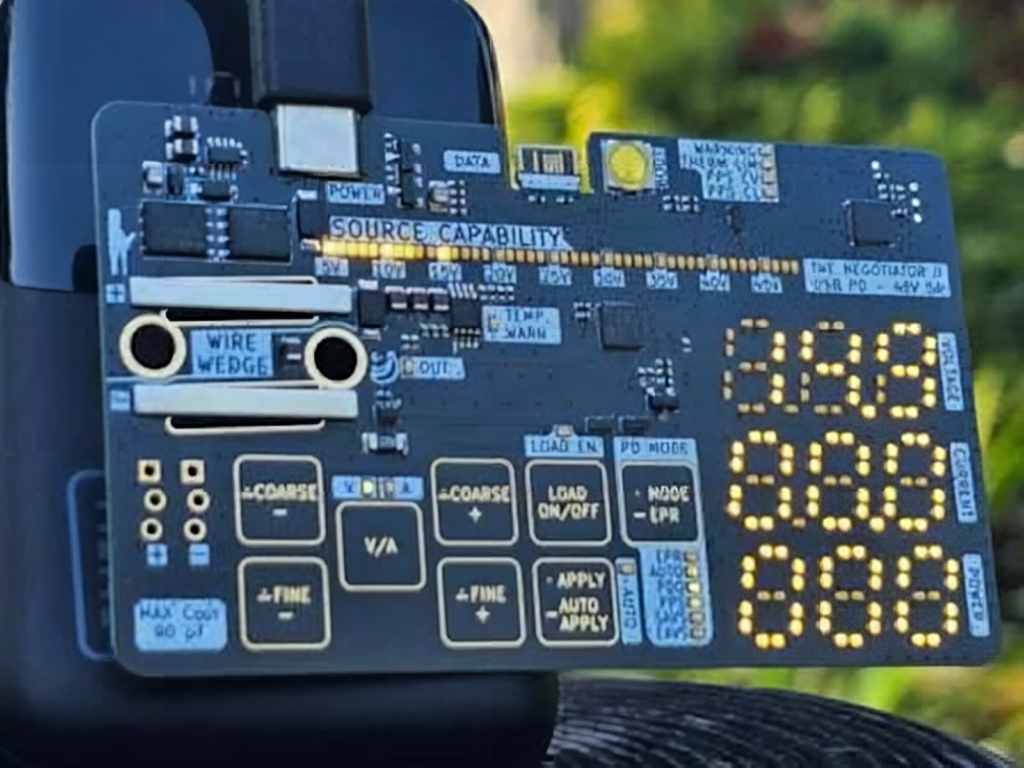
Got a spare Saturday and a drawer full of USB-C chargers? Anas Malas turned that drawer into a bench power supply, and the whole thing fits in a wallet. His Negotiator II is a USB Power Delivery card that asks a charger for the voltage you want, then hands it to your breadboard.
What they built
The card is about 2 mm thick, built on a 0.8 mm four-layer PCB. It speaks USB PD 3.1, so a plugged-in charger or power bank gets scanned and an LED bar shows every voltage it can offer, from 5 V up to 48 V. Buttons step the request in 0.1 V increments, and separate displays show live volts, amps and watts. Indicator LEDs tell you whether the link is using PDO, PPS, SAVS or EAVS, and an auto mode picks whichever offers the most current at each voltage. Current tops out at 5 A, depending on the charger and cable. The original write-up is on Hackster.
Parts and cost reality
Roughly 200 LEDs sit on that board, and driving them from a 48 V input without a bulky buck converter was the tricky part. Malas used cheap 0402 LEDs rated 10 mcd at under 0.2 mA each, fed from an LDO, with firmware that throttles the display when it runs warm. For fault protection he skipped an expensive dedicated chip and used depletion-mode N-channel MOSFETs to cut the CC lines if VBUS shorts to them, then deliberately shorted 48 V onto CC to prove it. In batches of 100, the ENIG boards cost about $8 each. A second USB port feeds a browser console with graphs and firmware updates, and a “Wire Wedge” slot grips a stripped wire with no connector.
Spend your Sunday on this
The design is not open source yet, so start smaller. Buy a PD trigger module (a few hundred pesos at circuit.rocks), set it to 12 V, and power a breadboard rail from a spare laptop charger. Put a 1 kohm resistor and an LED across a 5 V rail first, then measure with a multimeter before you plug in anything at 12 V or higher. Check the charger label for its supported voltage list and keep an eye on the Negotiator II project page for the open source release.
Frequently Asked Questions
What voltages can the Negotiator II provide?
It negotiates USB PD 3.1 and can request anything the charger offers from 5 V to 48 V in 0.1 V steps, with up to 5 A depending on the charger and cable.
How does it survive a 48 V short on the CC pins?
Depletion-mode N-channel MOSFETs disconnect the CC lines during a fault, a cheaper approach than a dedicated protection chip. The builder tested it by shorting 48 V to CC.
What will I learn if I build this?
You learn USB PD negotiation modes (PDO, PPS, SAVS, EAVS), LDO and LED current budgeting, fault protection with MOSFETs and compact PCB layout, all good thesis material for ECE students.
