
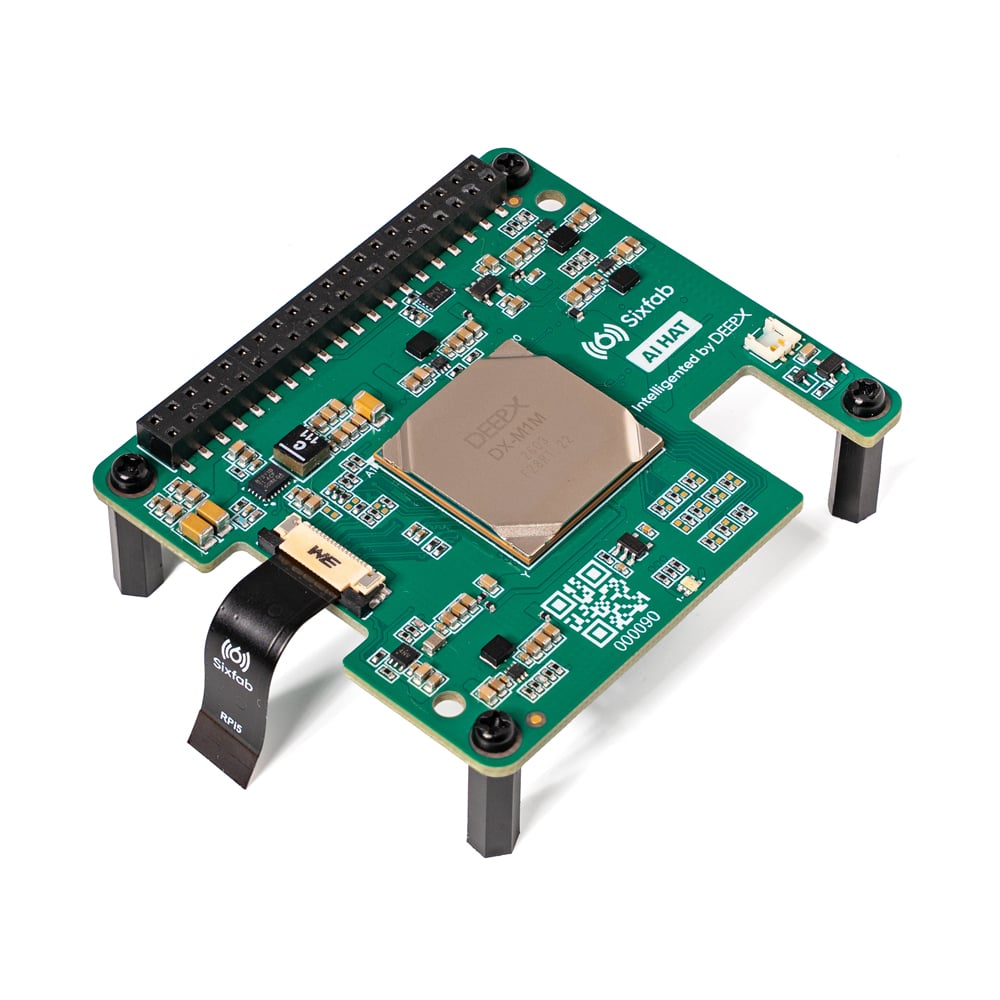
Can a Raspberry Pi 5 keep watching a camera feed all day without cooking itself or phoning home to a cloud server? Sixfab and DEEPX say yes, and the trick is an accelerator that stays near 3 W.
What is the Sixfab AI HAT+?
It is a third-party add-on board for the Raspberry Pi 5 built around the DEEPX DX-M1M NPU. The chip adds 25 TOPS of dedicated AI acceleration, so the Pi’s CPU stays free for camera handling, GPIO control, networking, and your own application code. The full write-up is on the Raspberry Pi news page.
One NPU covers three jobs. A CNN handles detection, segmentation, and pose estimation, and DEEPX ships YOLO-family models in its ModelZoo. A compact vision-language model can describe a scene or answer a question about a frame. A small language model can turn a spoken or typed command into an action, all on the board.
Why does 3 W matter more than 25 TOPS?
Peak TOPS looks great on a spec sheet, but your enclosure, battery, and heatsink care about sustained watts. Around 3 W of NPU power means a smaller case, often passive cooling, and inference that runs continuously instead of in bursts. Note that the 3 W figure is NPU-only, not wall power. Measure the whole system with your actual camera, storage, and cooling before you size a power supply.
The gotcha for thesis builds: a 25 TOPS number says nothing about model accuracy on your data. A YOLO detector trained on COCO will still miss your lab’s custom parts until you retrain it.
Try it on your own Pi 5
You need a Raspberry Pi 5, the Sixfab AI HAT+, a camera module on the CSI port, and a 5V/5A USB-C supply. Start with a stock detection model from the ModelZoo, build a GStreamer pipeline with DX-Stream, and log detections over MQTT to a dashboard. Then swap in a model you trained on your own classroom or lab images and compare frame rates. Raspberry Pi 5 boards and camera modules are available at circuit.rocks.
Frequently Asked Questions
What NPU does the Sixfab AI HAT+ use?
It uses the DEEPX DX-M1M, rated at 25 TOPS with roughly 3 W of typical sustained NPU power. It runs CNN vision models, compact vision-language models, and small language models on one toolchain.
Does the 3 W figure cover the whole Raspberry Pi 5 setup?
No. It is NPU power only. The Pi 5, camera, storage, and cooling add more, so measure total draw on your final build before choosing a power supply or battery.
What will I learn if I build this?
You learn how to run object detection on-device with GStreamer pipelines, how power and thermal budgets shape an edge AI design, and how to retrain a YOLO model on your own images for a thesis or classroom project.
