
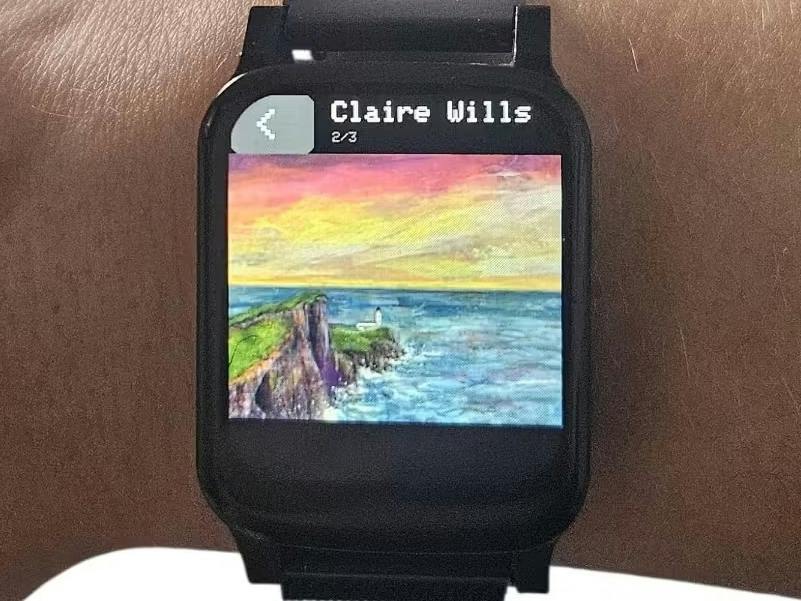
Grab an ESP32-S3 board, a 1.69-inch color touchscreen, a 350 mAh LiPo cell, a small vibration motor, and a 20 mm watch strap. That parts list is basically EWatch, an open source smartwatch by Ewan Wills that you can reprogram from the first boot.
What Ewan built
Commercial smartwatches lock down their firmware. EWatch goes the other way: it behaves like a normal ESP32 dev board that happens to sit on your wrist. Wills spent more than five years on it, moving from breadboards and hand-wired prototypes to several generations of custom PCBs. The current two-layer ENIG board measures 34 x 28 mm and packs Wi-Fi, Bluetooth Low Energy, an IMU, USB-C, and I2C and UART breakouts for extra sensors.
The technical bits worth stealing
The power design is the interesting part. A latching power circuit lets software cut the battery completely, yet the watch still keeps time while it is off. Charging and battery-level monitoring are handled on the board, so you do not need to bolt a fuel gauge module onto a breadboard. Open source drivers cover the display, touch controller, IMU, BLE, charger, and sleep modes, and you can write firmware in Arduino IDE, PlatformIO, or ESP-IDF using C, C++, MicroPython, or Rust.
- MCU: ESP32-S3 with Wi-Fi and BLE
- Display: 1.69 inch color touchscreen
- Battery: 350 mAh with on-board charging
- Pricing: $78 bare board and screen, $131 kit, $171 assembled with EWatchOS
The gotcha list is honest: the display connector is still finicky, enclosure tolerances need work, and the docs are catching up.
Start your own wrist project
Before ordering anything, prototype the software on an ESP32-S3 dev board with a small SPI display. Wire the IMU over I2C (SDA and SCL, with 4.7k pull-up resistors if your module lacks them) and get a step counter working first. For a capstone or a school hackathon, the watch form factor forces real decisions about sleep current and battery life. Read the full build notes at Hackster, then check circuit.rocks for ESP32-S3 boards and displays.
Frequently Asked Questions
What microcontroller does EWatch use?
EWatch runs on an ESP32-S3 with Wi-Fi and Bluetooth Low Energy, driving a 1.69-inch color touchscreen, an IMU, and a vibration motor on a 34 x 28 mm PCB.
How much does EWatch cost and what languages can I use?
Three versions exist: $78 for the board and screen, $131 as a kit with battery and strap, and $171 fully assembled. Firmware can be written in C, C++, MicroPython, or Rust.
What will I learn if I build this?
You will learn low-power design, latching power circuits, battery charging, I2C sensor reading, touch display drivers, and how to write firmware with Arduino IDE, PlatformIO, or ESP-IDF.
