
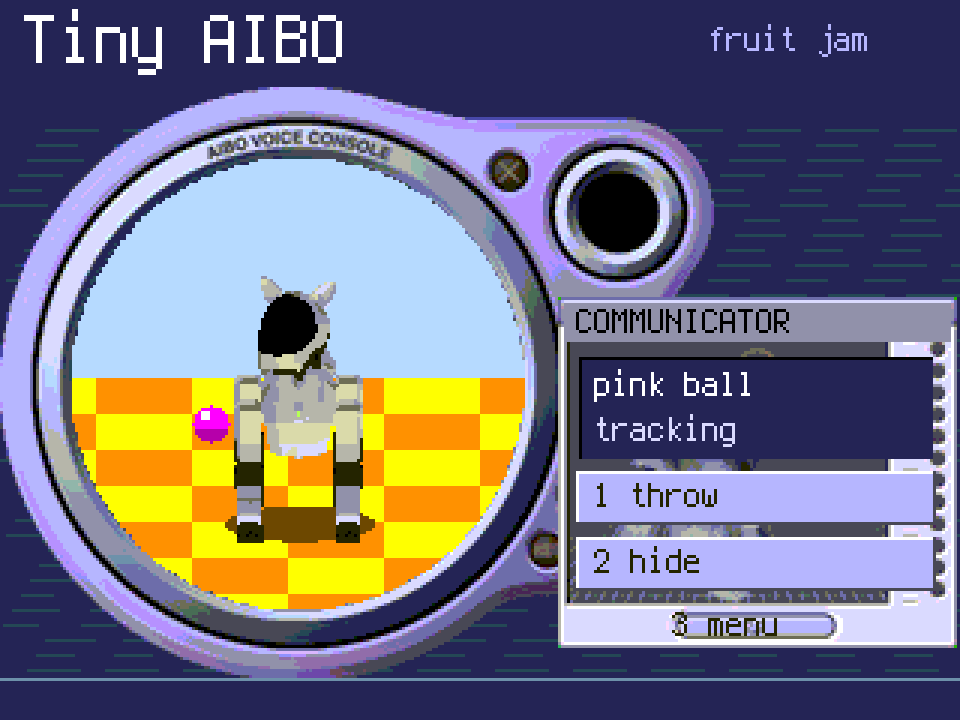
Sony killed off its original AIBO robot dog lineup years before most of today’s ECE students were born, but a project called AiboJam brings the digital ghost of that pet back to life on a $39.95 microcontroller board. No motors, no plastic paws, just a software recreation of Sony’s discontinued Tiny AIBO running live on Adafruit’s Fruit Jam.
AiboJam splits the work between two layers. CircuitPython handles the menus, button input, and pet behavior, while a native C module does the actual 3D rendering in real time. The model itself carries 27 rigid meshes, 1,662 vertices, and 2,620 triangles, played back through 49 motion clips (25 original Tiny AIBO animations plus 24 adapted from Sony’s older ERS-210 unit) and 17 sound clips across five selectable skins. The dog tracks a simulated pink ball on screen instead of a camera feed, though the developer notes Fruit Jam can now handle webcam input too, and says that project is next.
What’s inside the board
- RP2350B microcontroller running at 150 MHz
- 520 KB of onboard SRAM plus 8 MB of PSRAM
- 16 MB of flash storage
- 320×240 RGB332 framebuffer over DVI output
- Three onboard buttons handle all input, no keyboard or mouse required
That’s a lot of silicon for under $40, and it explains how a native C renderer can run at all inside CircuitPython, a language that’s normally interpreted and slower. The framebuffer draws pixel-doubled to fill the 320×240 screen, the same trick older consoles used to stretch a small buffer across a bigger display without recalculating every pixel by hand. Budget for a display, USB-C power supply, and cables on top of that board price too; Adafruit lists those as separate purchases, so $39.95 buys the bare board only.
Want to try it yourself? Adafruit’s Fruit Jam hardware page lists the pinout, memory map, and PCB source files, and the AiboJam build notes are up on the original Adafruit blog post. Read through the CircuitPython library docs before touching the C renderer; the native-code side is newer and has fewer worked examples to copy from.
Frequently Asked Questions
What board does AiboJam run on and what does it cost?
It runs on Adafruit’s Fruit Jam, built around an RP2350B microcontroller at 150 MHz with 520 KB SRAM, 8 MB PSRAM, and 16 MB flash. The bare board is $39.95; a display, USB-C power supply, and cables are separate purchases.
Does AiboJam use a camera to track the ball the robot dog follows?
No. The pink ball is simulated inside the framebuffer, not read from a camera feed. The developer notes Fruit Jam now supports webcam input and plans a follow-up project that uses it.
What will I learn if I build something like this?
You’ll work with CircuitPython for input handling and menus alongside a native C module for real-time 3D rendering, which is a good introduction to mixing an interpreted language with compiled code on the same microcontroller. It also covers reading a board’s pinout and memory map before writing to it, a habit worth building before your first embedded systems project or thesis build.
