
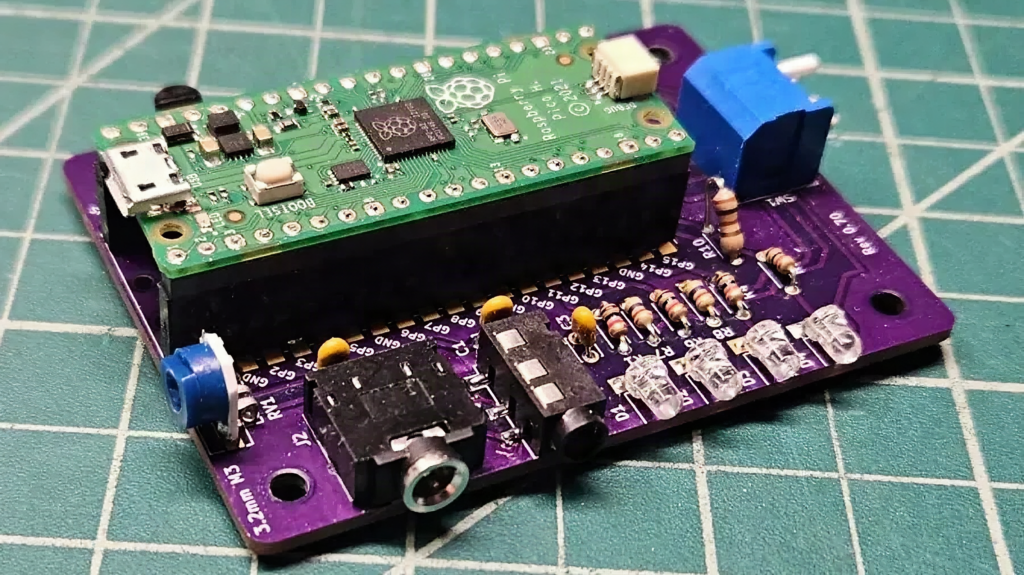
The Heathkit HK-21 Pocket Packet modem hasn’t been made since the 1980s, and a working used unit now sells for more than most hobbyists spent on the original kit. Maker btech skipped the hunt for a dead board and rebuilt the whole thing around a $4 Raspberry Pi Pico.
What the Pocket Pico Actually Does
The project, called Pocket Pico, works as a terminal node controller (TNC) for amateur packet radio. Instead of reverse-engineering the HK-21’s behavior from scratch, btech runs a Z80 processor emulator directly on the Pico‘s RP2040 chip, then loads the original Heathkit firmware onto that virtual Z80. The Pico‘s second core handles the analog side: modulating and demodulating Bell 202 tones (1200 Hz mark, 2200 Hz space) at 1200 baud, the same scheme every packet TNC has used since the 1980s.
Because it runs the real HK-21 firmware, the Pocket Pico talks to decades-old packet software with no changes on either end. It handles APRS, AX.25 Level 2 connections, and hosts a personal bulletin board system so other stations can leave messages while the operator is off the air.
The Technical Tradeoff
Emulating an 8-bit CPU on a 133 MHz dual-core Arm Cortex-M0+ sounds like overkill, and it partly is, but it solves a real problem: sourcing a Z80 and its support chips in 2026 costs more in shipping than the whole Pico. The RP2040‘s PIO peripheral generates the audio tones directly on a GPIO pin, so there’s no separate modem chip and no analog filter stage to tune by hand.
- RP2040: dual-core Arm Cortex-M0+ at 133 MHz
- Modem standard: Bell 202 AFSK, 1200 baud
- Protocols supported: AX.25 Level 2, APRS
- Firmware: original Heathkit HK-21 binary, run under emulation
Build It Yourself
btech published the firmware and wiring notes on the project page linked above. The build needs a Pico, an audio cable wired to your radio’s mic and speaker jacks, and a breadboard to prototype the connections before soldering anything permanent. For a ham radio club or a robotics team looking at legacy protocols, this is a working AX.25 stack for under 300 pesos in parts, not counting the radio.
Frequently Asked Questions
What does the Pocket Pico actually run?
What parts do I need to build one?
A Raspberry Pi Pico, an audio cable wired to your radio’s mic and speaker jacks, and a breadboard for prototyping. Total parts cost is under 300 pesos, not counting the radio itself.
What will I learn if I build this?
You’ll pick up RP2040 PIO programming, the Bell 202 AFSK modulation scheme every packet radio TNC uses, and how AX.25 framing works under APRS, skills that carry directly into embedded radio and IoT projects.
