
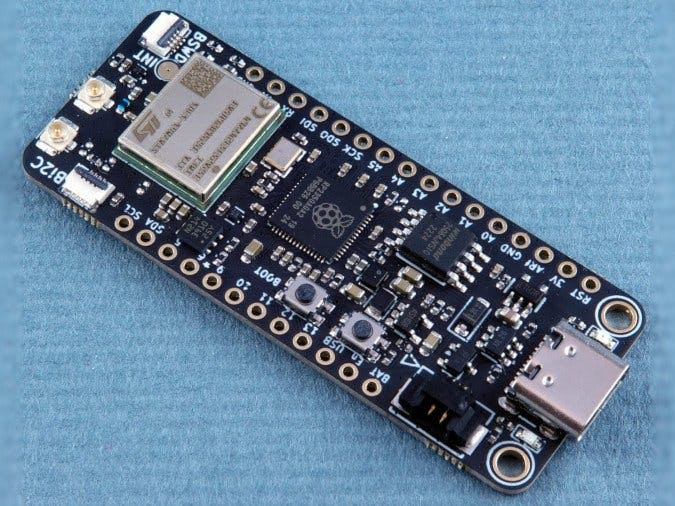
What if one breadboard-friendly stick could reach a cellular tower, fix its own GPS position, and still run CircuitPython? That is the pitch behind iLabs’ new Challenger+ RP2350 NB-IoT.
The board drops Raspberry Pi’s RP2350 microcontroller onto a Feather-format stick and pairs it with an STMicroelectronics ST87M01-1301 NB-IoT radio. NB-IoT is the low-power, narrowband cellular standard built for sensors that send small packets over long distances on battery, so a soil probe or a parking counter can phone home without WiFi or a nearby gateway. Because it follows the Feather footprint, it slots into the Challenger ecosystem and sits on a standard breadboard, and it charges a LiPo battery straight over USB-C. You can flash it from Arduino, MicroPython, or CircuitPython.
What are you actually getting?
The RP2350 is a two-of-four-core part: you pick any two from a pool of Arm Cortex-M33 and open-hardware Hazard3 RISC-V cores, clocked up to 150MHz, with 520kB of on-chip SRAM and 8MB of external flash. A PIO block hands you 12 state machines for bit-banging custom protocols. The ST87M01 module speaks 3GPP Release 15 Cat-NB2 across bands B1, B3, B5, B8, B20, and B28, pushing 159kb/s uplink and 127kb/s downlink. It also carries a GNSS receiver running GPS L1 and Galileo in concurrent mode with assisted-GNSS, and it can scan 2.4GHz 802.11b access points for rough indoor positioning. The 0.1″ headers break out SPI, I2C, UART, ADC/DAC, and PWM.
Worth putting on your bench?
If your thesis or capstone has to report data from somewhere with no WiFi, a rice field, a rooftop, a moving jeepney, this is the kind of board that deletes the gateway from your bill of materials. Read Pontus Oldberg’s full spec rundown on Hackster before you commit, then check whether Cat-NB2 is live on your local carrier, since NB-IoT coverage still varies by region. Start small: wire one I2C sensor to the SDA and SCL pins, log a reading, and push it over the cellular link.
Frequently Asked Questions
How does the Challenger+ RP2350 NB-IoT get online without WiFi?
It carries an STMicroelectronics ST87M01-1301 NB-IoT module, a narrowband cellular radio that connects straight to a mobile network on bands B1, B3, B5, B8, B20, and B28. Your sensor phones home over the carrier signal, so no local WiFi or LoRa gateway is needed as long as Cat-NB2 coverage exists in your area.
What can I program it with, and how is it powered?
The RP2350 runs Arduino, MicroPython, or CircuitPython, so you can start in whichever you already know. Power and data come over USB-C, and it charges an optional LiPo battery from USB-C or the VUSB pin, which makes it practical for battery-powered field nodes.
What will I learn if I build with this board?
You practice wiring I2C and SPI sensors to real GPIO headers, reading GNSS position data, and pushing readings over a cellular link, plus power budgeting for a battery node. Those are the exact skills a remote-monitoring thesis or capstone demands.
