
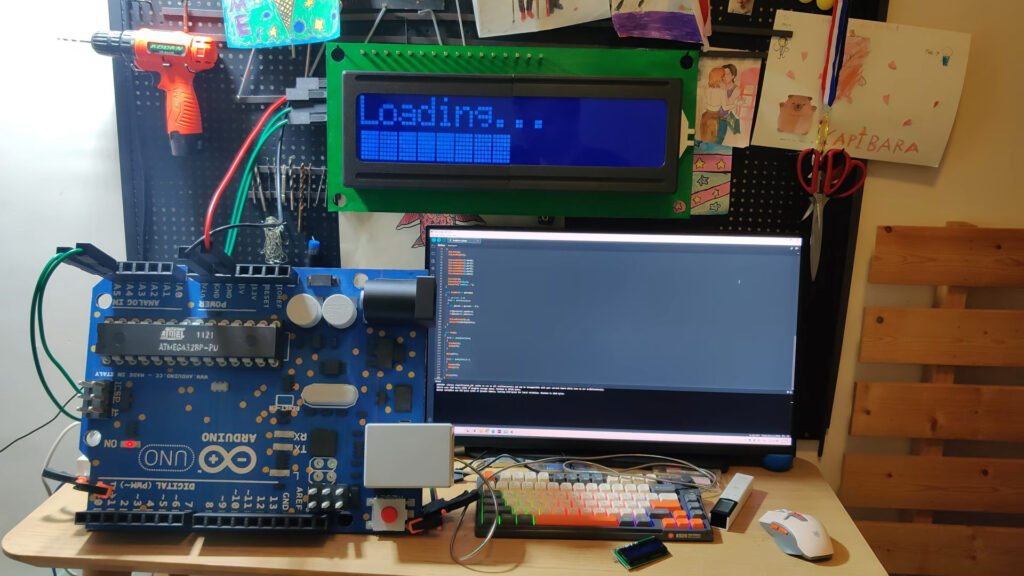
What do you get when you rebuild a pocket-sized 16×2 character LCD at seven times scale? Over a thousand addressable LEDs, a stack of custom PCBs, and a display you can read from across the room.
Maker Uncle Stem wanted the exact look of the classic 1602 character module, just enormous. Real liquid crystal is hard to fabricate at home, so rather than chase that, the build recreates every segment with addressable LEDs instead. Each of the 32 character cells got its own small PCB, and the cells were joined with lengths of nickel strip, the same conductive ribbon people spot-weld onto 18650 Li-ion cells. The finished panel is a working 7:1 replica that still behaves like the tiny original it copies.
How does it still act like a normal 1602?
The clever part is an RP2040 sitting behind the panel, pre-loaded with the standard 1602 character set. It exposes the same I2C interface as the off-the-shelf module, so any Arduino sketch built on the LiquidCrystal_I2C library talks to it over SDA and SCL with no code changes at all. Send it text and the microcontroller maps each glyph onto the correct LEDs across those per-character PCBs. To populate more than a thousand LED footprints without paying for a pick-and-place, Uncle Stem squeegeed solder paste through a 3D-printed stencil, then hand-placed and reflowed each board. Brass rods stand in for the header pins at 7:1, and oversized jumper wires finish off the retro look. Even the green board everything mounts to is a scaled-up PCB, printed to mirror the 1602 module down to its familiar silkscreen.
Want to try a smaller version first?
You do not need a thousand LEDs to learn the idea. Wire a short WS2812 strip to a Raspberry Pi Pico (also an RP2040, around ₱250 at circuit.rocks), drive it at 5V, and map a 5×8 font onto the pixels in your code. Even a single giant character teaches you addressable-LED timing, GPIO output, and how a character LCD packs glyphs into a fixed grid. Watch the full build on Uncle Stem’s video for the wiring details, then scale your own version up one character at a time as your budget allows.
Frequently Asked Questions
How does the giant display talk to an Arduino?
It hides an RP2040 that emulates a standard 1602 module over I2C, so the LiquidCrystal_I2C library drives it over SDA and SCL with no code changes.
How were over a thousand LEDs soldered by hand?
Each character sits on its own PCB, and solder paste was applied through a 3D-printed stencil before hand-placing and reflowing the addressable LEDs.
What will I learn if I build this?
You will practice addressable-LED timing, I2C communication, and GPIO control on an RP2040, plus how character LCDs map glyphs onto a pixel grid, skills that carry straight into robotics and IoT projects.
