
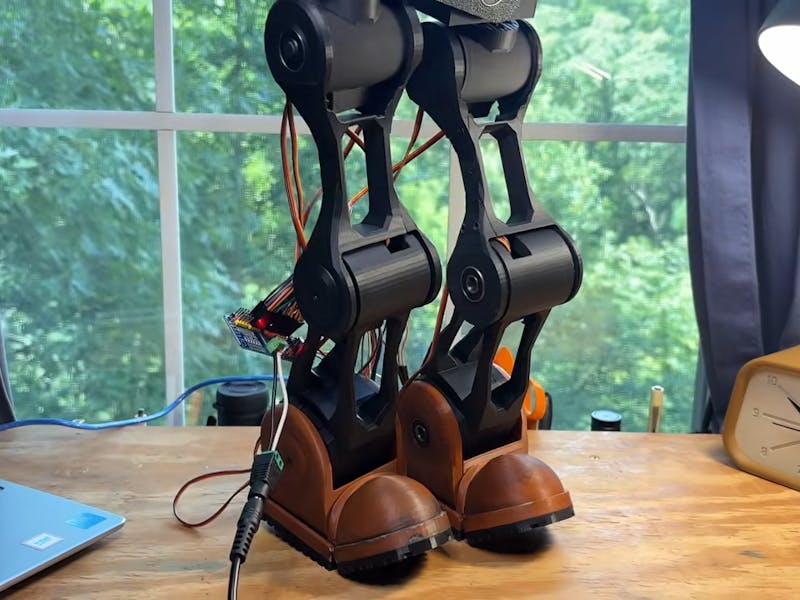
A decade ago, a homebrew humanoid robot meant machined aluminum, a four-figure budget, and a garage full of tools. Maker Oliver Paff just skipped past all of that and built a working pair of walking robot legs on a hobby-servo budget, and he did it before even bolting on a torso.
The legs are a proof of concept for how cheap a bipedal build has gotten. Paff modeled every bracket in OnShape and printed the parts at home, so the mechanical side cost him plastic and time rather than a machine shop invoice. What makes the project worth studying is the electronics stack underneath, because that is the part any student can copy for a robotics thesis or a competition entry.
What’s driving the legs
Each leg is actuated by hobby servos, and eight of them together is more than an Arduino wants to drive off its own timers. So Paff paired an Arduino Mega 2560 with a PCA9685 board. The PCA9685 is a 16-channel, 12-bit PWM controller that talks to the Mega over I2C, using only the SDA and SCL pins. That hands off all the pulse generation to a dedicated chip and frees the microcontroller to run the gait logic. The eight servos are MG996R units, each good for roughly 10 kg-cm of torque at 6V, which is enough to swing a printed leg through a step. A community walking-gait library got the first steps working, and Paff says smarter routines are next.
Build it yourself
You do not need a lathe to try this. The shopping list is short: an Arduino Mega 2560, a PCA9685 servo driver breakout, eight MG996R servos, jumper wires, and a separate 5-6V supply rated for the stall current. That last item is the gotcha. MG996R servos can pull well over 1A each under load, so never feed them from the Arduino’s onboard 5V pin, wire them to their own supply and tie the grounds together. Start with the Adafruit PCA9685 library, get one servo sweeping on channel 0, then scale up. Full build notes and Paff’s approach are on the original Hackster write-up.
Frequently Asked Questions
What microcontroller and driver run these robot legs?
An Arduino Mega 2560 handles the walking logic, and a PCA9685 16-channel PWM board drives all eight MG996R servos over I2C so the Mega does not have to generate every pulse itself.
Do you need to solder to build a servo robot like this?
Not much. The servos and PCA9685 breakout use plug-in headers, so most of the wiring is jumper cables. You mainly need a separate 5-6V supply that can handle the servos’ stall current instead of powering them from the Arduino.
What will I learn if I build this?
You practice CAD and printing mechanical brackets, I2C communication between a microcontroller and a PWM driver, powering high-current servos safely, and writing a basic walking gait in code. It is a strong foundation for a robotics thesis or competition build.
