
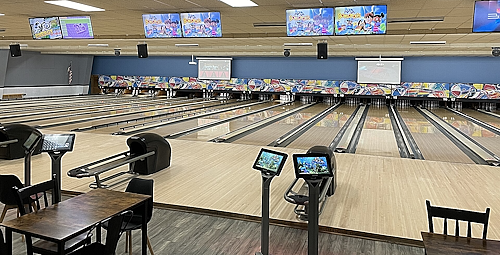
What do you do when the quote to fix your bowling alley’s scoring comes back at $80,000?
A Hacker News poster going by section33 bought an abandoned 8-lane center and got exactly that number, with parts alone running about $4,000 per lane pair. Then he opened up the pinsetters. The 70-year-old machines are almost purely mechanical, and the expensive “advanced” controller they were paying for mostly just closed one relay to kick the pinsetter. That is a job for a $6 microcontroller, not a six-figure cabinet. His replacement, OpenLaneLink, lands somewhere around $200 to $400 per lane pair, or roughly $1,600 for the whole house.
How the wiring actually works
Each lane pair gets an ESP32 node. The node watches IR break-beam sensors to detect a ball crossing the foul line and the pins falling, reads machine state through optocouplers so the 1950s wiring never touches a 3.3V GPIO pin directly, and fires a relay to trigger the pinsetter cycle. Optocoupler isolation is the part worth copying: bowling machines run mains-adjacent voltages and back-EMF from those motor contactors will happily kill an ESP32 that is tied straight to them.
The nodes talk over ESP-NOW, Espressif’s connectionless 2.4 GHz protocol that skips the whole Wi-Fi association handshake, so a pin-fall event reaches the gateway in single-digit milliseconds without a router in the loop. RS485 sits underneath as a wired fallback, which is the right call in a metal-heavy building full of motors. A gateway node connects over UART to a Raspberry Pi running Redis and a scoring state machine, and from there it is a normal web stack: middleware, React, and WebSocket pub-sub. Any front-end dev on the team can build a lane UI without touching firmware.
Try a smaller version of this
You do not need a bowling alley to practice the pattern. Wire an IR break-beam pair to two ESP32s, send the trip event over ESP-NOW, and push it to a Pi over UART at 115200 baud. That is the same sensor-to-mesh-to-server chain, minus the pinsetters. Add a PC817 optocoupler on the input side and you have handled the isolation lesson too. Watch out for one gotcha: ESP-NOW and Wi-Fi station mode must share a channel, so lock the channel explicitly if your gateway is also online.
The full architecture write-up, including planned DMX light shows and tap-to-pay kiosk bowling, is in the Hacker News thread. The author says hardware, firmware, and software will be open sourced once it stabilizes.
Frequently Asked Questions
How do the ESP32 nodes detect a bowling ball and falling pins?
Each lane-pair node reads IR break-beam sensors for ball and pin events, and reads pinsetter machine state through optocouplers so the old mains-adjacent wiring never touches a 3.3V GPIO pin. A relay on the output side triggers the pinsetter cycle.
What does OpenLaneLink cost compared to a commercial system?
Commercial replacement quotes came in at $80,000 to $120,000, roughly $4,000 per lane pair in parts. The ESP32 build runs about $200 to $400 per lane pair, so an 8-lane house lands near $1,600.
What will I learn if I build this?
You practice the full sensor-to-server chain: break-beam sensing, optocoupler isolation between high-voltage machinery and a microcontroller, relay driving, ESP-NOW mesh networking, RS485 as a wired fallback, and UART into a Raspberry Pi running Redis and a state machine. Those isolation and industrial-bus skills transfer straight into thesis and capstone automation projects.
