
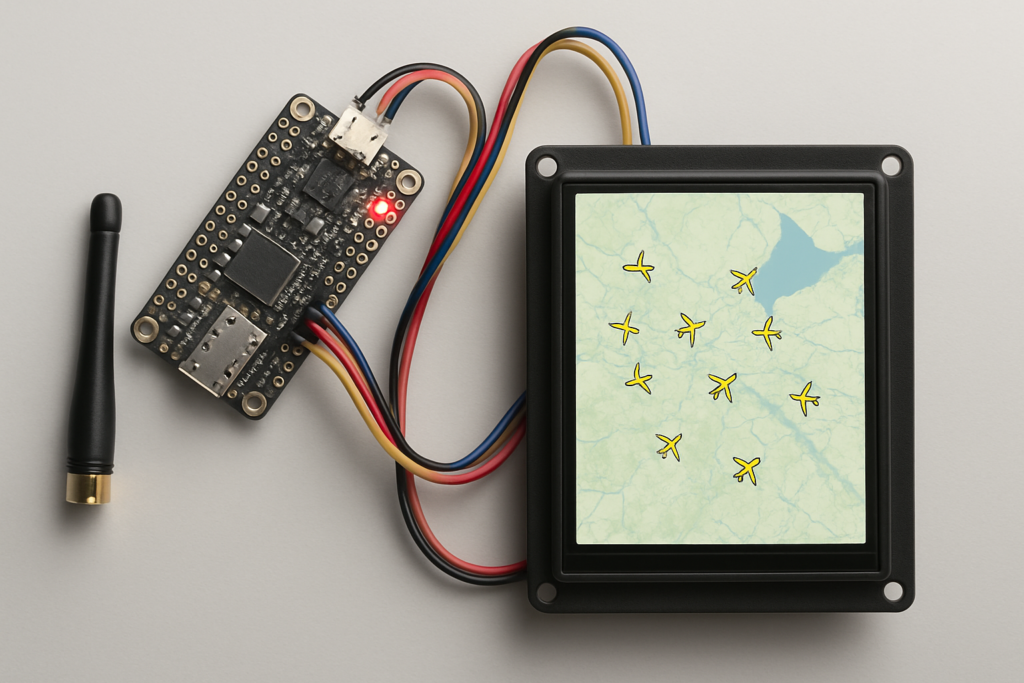
Got a free Saturday and a soft spot for aviation? Point a small antenna at the sky and watch planes pop up on a screen you wired together yourself. Adafruit’s latest 3D Hangouts stream showed Pedro doing exactly that: a desktop flight tracker running on the Feather RP2350, complete with a lunar transit feature that flags when an aircraft is about to cross the face of the Moon.
What you would be building
The tracker listens for ADS-B signals that aircraft broadcast on 1090 MHz, decodes each plane’s callsign, altitude, and position, then plots them on a color display. Pedro paired the RP2350 with the 3.5″ TFT FeatherWing V2, a 480×320 touchscreen that stacks straight onto the Feather headers with no breadboard wiring needed. The lunar transit math is the fun part. The code cross-references plane positions against the Moon’s azimuth, so you get a heads-up before a silhouette shot lines up.
The parts and the real cost
The RP2350 brings 8MB of PSRAM, which matters here because holding dozens of live aircraft tracks plus a framebuffer eats RAM fast. You feed it ADS-B data from a small SDR dongle tuned to the 1090 MHz band. Wiring is mostly stacking FeatherWings, though you will solder headers onto the RP2350 if it ships bare. Budget-wise, expect to spend a few thousand pesos on the Feather and TFT FeatherWing combo at circuit.rocks, plus an antenna and dongle you may already own.
Spend your Sunday on it
Start with the display: flash CircuitPython, get the TFT drawing a test grid, then layer in the ADS-B parser. If your screen stays white, check the SPI chip-select pin, it is the usual culprit on stacked FeatherWings. Watch Pedro’s full walkthrough on the Adafruit 3D Hangouts stream, then grab the Feather RP2350 to start. The same stream also wrapped Liz Clark’s CircuitPython chiptune player on a PCM5102 I2S DAC, a quieter second project if planes are not your thing.
Frequently Asked Questions
How does the flight tracker know where planes are?
It listens for ADS-B signals that aircraft broadcast on 1090 MHz, then decodes each plane’s callsign, altitude, and GPS position and plots them on the TFT display.
What parts do I need to build it?
A Feather RP2350 with 8MB PSRAM, the 3.5-inch TFT FeatherWing V2 for the screen, an ADS-B source like an SDR dongle, and an antenna. The two boards stack together using headers you solder on.
What will I learn if I build this?
You’ll practice reading a live radio data stream, decoding a real-world protocol (ADS-B), driving an SPI TFT display, and managing limited RAM on a microcontroller, all skills that carry straight into any embedded or IoT thesis project.
