
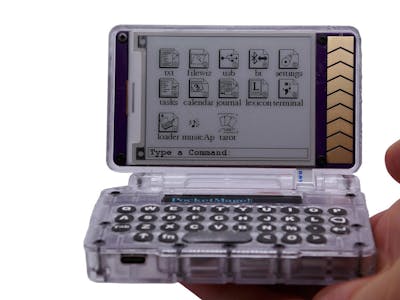
Picture a cafe at 7 a.m.: laptops glowing, phones buzzing, and one person quietly typing on a pocket-sized slab with a matte, paper-like screen that never once flashes a notification. That device is the PocketMage, and its creator, YouTuber Ashtf, just took it from a workbench prototype to a live crowdfunding campaign.
A PDA built to do less, on purpose
The PocketMage revives the late-90s personal digital assistant and strips out the distractions. No social feed, no notification badge, nothing pulling your eyes off the cursor. What you get instead is a full tactile QWERTY keyboard, a capacitive touch bar for scrolling, and a folding shell that genuinely fits in a pocket. Out of the box it runs a Markdown editor, calendar, journal, dictionary, and a terminal, so it handles writing, note-taking, and light coding without ever booting a browser.
What sits under the shell
The brain is an ESP32-S3 with 16 MB of flash and 2 MB of PSRAM, plenty for text work while sipping battery. The clever part is a dual-display setup: a 3.1-inch, 320 x 240 E Ink panel carries long-form reading and writing, while a slim 1.8-inch OLED takes over menus and anything that needs a fast refresh. A 1,200 mAh battery, USB-C charging, Wi-Fi, Bluetooth, a microSD slot, and a real-time clock round out the hardware. For tinkerers, an expansion connector breaks out GPIO, I2C, SPI, and UART, so you can solder on your own sensors or add-on modules.
Open from silicon to source code
Everything runs on a custom FreeRTOS-based OS that is fully open source, and both the hardware and firmware ship under the Apache-2.0 license. You can sideload third-party apps, write your own, and push changes back upstream. A kit costs $185, an assembled unit $235, with the full breakdown on the Hackster writeup and the Crowd Supply page.
For an ECE student or a school robotics club, the PocketMage is a working reference design for a real product: a dual-screen embedded device with power management, a keyboard matrix, and a bus expansion header you can study and copy. Want to try the idea on your own bench? Wire a 320 x 240 SPI E Ink panel to an ESP32-S3 dev board, get text rendering over SPI working first, then hang the OLED off I2C for menus.
Frequently Asked Questions
What microcontroller and displays power the PocketMage?
It runs on an ESP32-S3 with 16 MB of flash and 2 MB of PSRAM, paired with a 3.1-inch 320 x 240 E Ink panel for text and a 1.8-inch OLED for fast-refreshing menus.
How much does the PocketMage cost and how do I get one?
A self-assembly kit is $185 and a fully assembled unit is $235, both available through the crowdfunding campaign on Crowd Supply.
What will I learn if I build a device like this?
You will practice driving an E Ink panel over SPI, running an OLED over I2C, wiring a keyboard matrix, managing a Li-ion battery over USB-C, and structuring firmware on FreeRTOS, which are core skills for any embedded or thesis project.
