
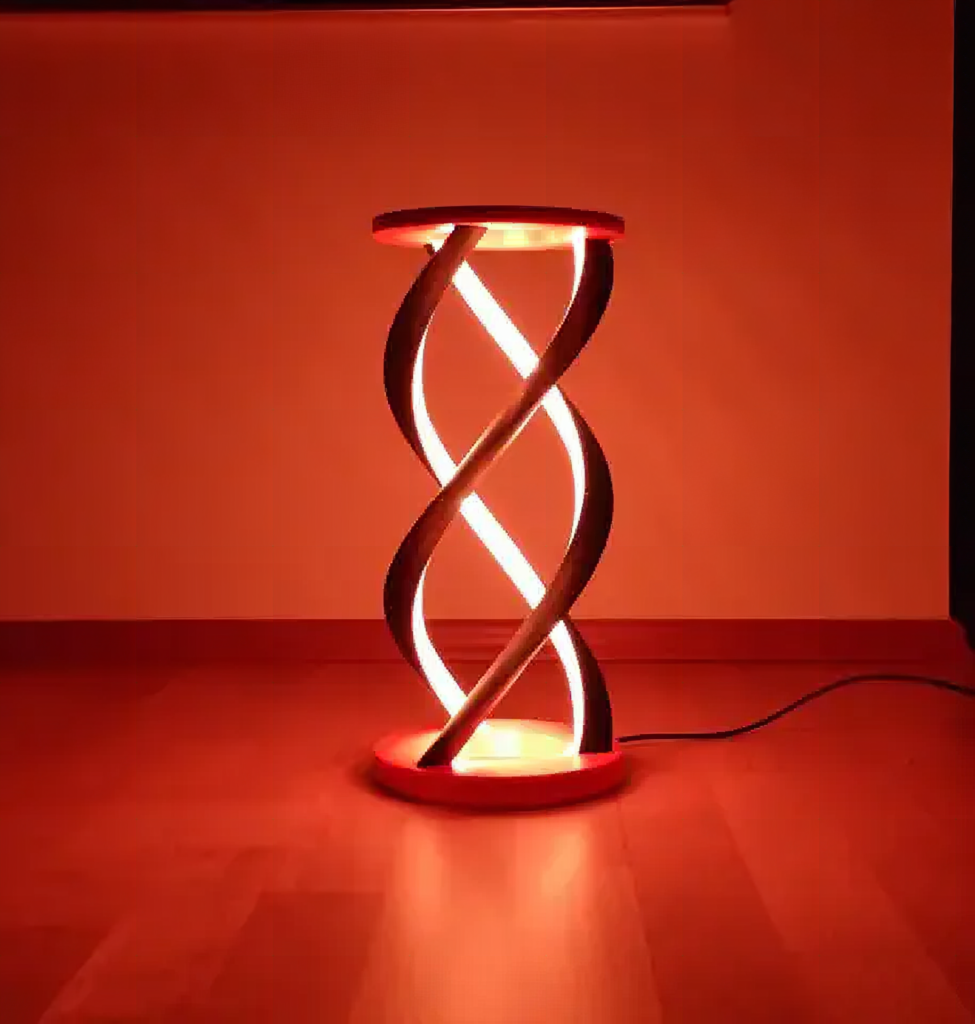
Picture a quiet evening room with a tall, twisting column of light in the corner, its diffuser segments breathing slow waves of color from floor to ceiling. That is the effect maker Basti85 chased with a large 3D-printed spiral lamp, and the glow is driven entirely by an addressable LED strip and a tiny microcontroller hiding inside the base.
What got built
The project is a floor-standing spiral lamp assembled from stacked printed segments. The structural body prints in standard PLA, while the light-shaping diffuser rings print in transparent filament so the LEDs underneath bleed into a soft, continuous gradient rather than sharp dots. An addressable LED strip spirals up the inside of the column, and because every pixel is individually controllable, the whole tower can sweep through animations, react to music, or settle into a single warm tone for the evening.
How it comes together
The brains of the build is an ESP32-C3, with an ESP8266 D1 mini listed as a fallback if that is what is already on your bench. Both run WLED, the popular open-source firmware that turns an ESP board into a Wi-Fi-controlled lighting hub you can drive from a phone browser or fold into a smart-home setup. The version-two release pairs the printable files with a full WLED configuration walkthrough, so the fiddly part of mapping the strip length, setting the right LED type, and saving presets is documented instead of guesswork. Print the body, print the diffusers, thread the strip, flash the firmware, and the lamp is effectively a giant programmable pixel.
Make one yourself
The shopping list is refreshingly short: an ESP32-C3 (or ESP8266), an addressable LED strip such as WS2812B, a 5V supply sized to the pixel count, and a couple of spools of PLA. WLED handles the software side for free, and the printed parts mean the enclosure costs only filament and time. A quick tip before you order: count your LEDs first, because a tall spiral can pull several amps at full white, and an undersized supply is the most common reason a first WLED build flickers or browns out. If you have wanted a project that is equal parts 3D printing and embedded electronics, a spiral lamp is a satisfying weekend-scale build that ends with something genuinely nice to look at every night.
Frequently Asked Questions
What microcontroller controls the spiral lamp?
What do I need to print and buy to build one?
What will I learn if I build this?
You will get hands-on practice flashing and configuring WLED, wiring and powering an addressable LED strip safely, and combining multi-part 3D prints with embedded electronics, a great crossover of 3D printing and microcontroller skills.
