
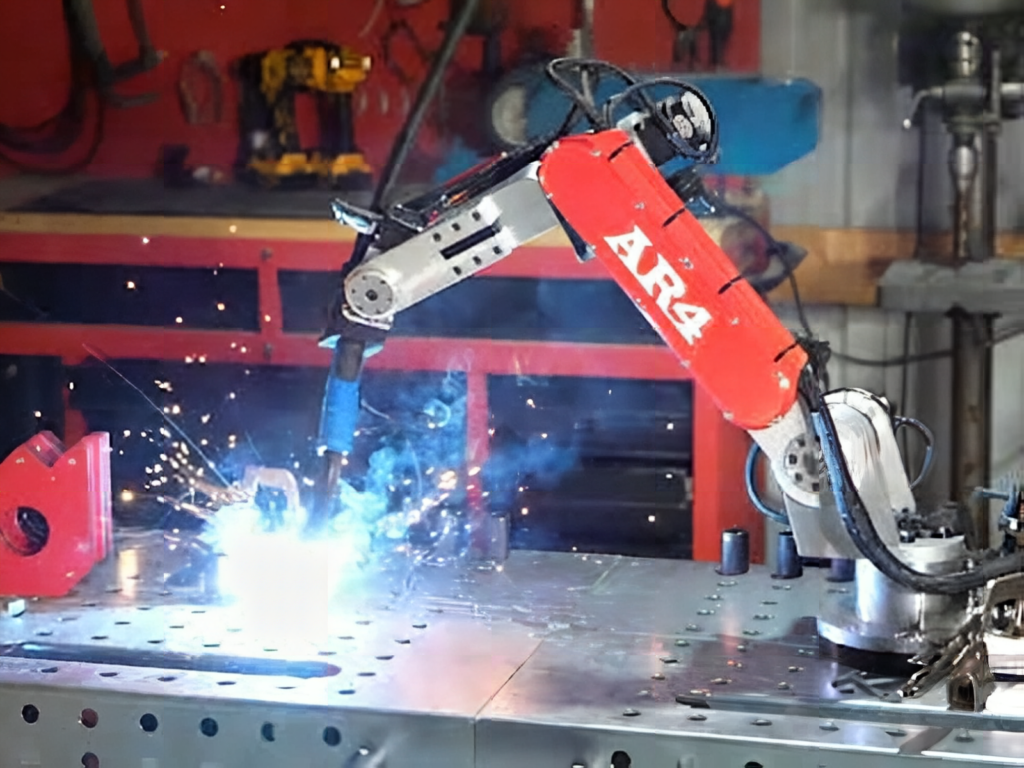
A six-axis robot arm sitting on your desk used to mean five figures and a service contract. Chris Annin’s AR4 quietly tore that idea up — and with the brand-new Mark 5 revision, he’s calling the hardware officially finished.
The AR4 is an open-source, six-degrees-of-freedom robot arm you build yourself from CNC-cut aluminum, 3D-printed parts, and off-the-shelf motors and electronics. It’s the latest in a lineage that started with the AR2 and has been refined release after release. The Mark 5 isn’t a dramatic redesign so much as a final polish: Annin says it’s the last item on his hardware to-do list, with future effort going into software and tutorials instead.
What changed in the Mark 5
The headline tweak is sensing. Joints one, two, and three now use Hall effect sensors for their calibration limit switches instead of mechanical microswitches, which meant reworking a few mounting points on the aluminum parts. Joints four, five, and six keep the small microswitches. Annin has also shipped a fresh build manual and published the arm’s modified Denavit-Hartenberg parameters — the math that describes how each joint moves — as fully worked-out spreadsheets, so the kinematics aren’t a mystery you have to reverse-engineer.
Under the hood, the AR4 runs on a Teensy 4.1 with motors that have integrated encoders for closed-loop control, a setup carried over and tightened across earlier revisions. The control electronics live inside the base of the arm, and a larger base enclosure makes room for the terminal board and the gripper control board.
Build it yourself
This is a genuine DIY kit, not a toy. You’ll want a 3D printer for the printed components, the CNC metal parts and motors (kits and downloads are on the Annin Robotics site), and a Teensy 4.1 to act as the brain. The new build manual and DH parameter spreadsheets make it one of the more approachable paths into real industrial-style robotics — and there’s even a course aimed at schools, shaped by feedback from professors already using the AR4 in their classrooms. If you’ve got a Mark 4 already, there are upgrade instructions to bring it up to Mark 5 spec.
Frequently Asked Questions
What microcontroller powers the AR4 robot arm?
The AR4 runs on a Teensy 4.1, paired with motors that have integrated encoders for closed-loop control. The control electronics are housed inside the base of the arm.
What changed in the Mark 5 revision?
Joints one, two, and three switched from mechanical microswitches to Hall effect sensors for calibration, which shifted some aluminum mounting points. It also ships with a new build manual and worked-out Denavit-Hartenberg kinematics spreadsheets.
What will I learn if I build this?
You’ll get hands-on with 3D printing, CNC part assembly, stepper motors and encoders, and closed-loop motion control. Working through the Denavit-Hartenberg parameters also teaches you the real math behind robot-arm kinematics.
