
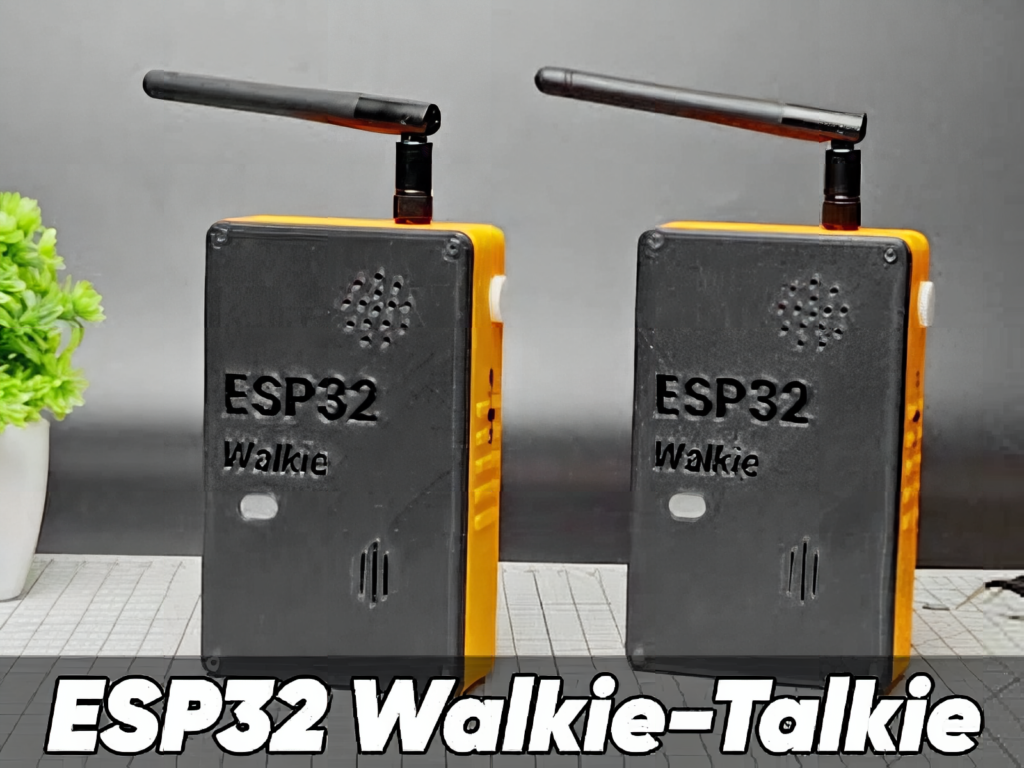
Off-grid communication keeps creeping back into the maker spotlight. As mesh radios like Meshtastic, LoRa pagers, and DIY intercoms gain followers, more builders are asking a simple question: how little hardware do you actually need to talk to someone when there’s no router, no cell tower, and no subscription? A recent build from YouTuber Tech Talkies lands squarely in that trend, turning a pair of tiny ESP32 boards into proper handheld walkie-talkies.
The build itself
Rather than leaning on licensed radio bands and dedicated transceiver chips, each handset talks over ESP-NOW, the low-latency peer-to-peer protocol baked into Espressif’s microcontrollers. That means the two units swap live voice with no Wi-Fi network and no internet in the middle. Each unit is built around a Seeed Studio XIAO ESP32S3 Sense, picked for its small footprint, its bolt-on microphone board, and crucially a version that accepts an external antenna for extra reach. Audio comes back out through a MAX98357 I2S amplifier driving a little 23mm speaker, all powered by a removable 18650 cell in a charging shield that doubles as a power bank.
The technical takeaway
The clever details are in the wiring. A push button serves as push-to-talk, and the creator flags a sneaky gotcha with the battery shield: its onboard switch only cuts the USB output, not the main rails, so a separate slide switch had to be wired in to fully kill power. Pairing is just as hands-on, you read each board’s MAC address and drop those IDs into the firmware before flashing through the Arduino IDE, which locks the two handsets to each other. Everything tucks into custom 3D-printed cases, and field testing held a clean link past 200 meters outdoors.
What to try next
This project is a great springboard. Swap in a higher-gain antenna and see how far the ESP-NOW link really stretches, or add a third board and experiment with broadcasting to a small group instead of a single pair. You could layer in a tiny OLED to show signal status, or repurpose the same audio-capture-and-stream pipeline for a baby monitor or a wireless doorbell. The point isn’t the walkie-talkie specifically, it’s that a couple of dollar-store-sized boards can now carry your voice across a field.
Frequently Asked Questions
How do the ESP32 walkie-talkies communicate without Wi-Fi?
They use ESP-NOW, a low-latency peer-to-peer protocol built into Espressif chips. The two handsets exchange voice directly after being paired by MAC address, so no router, hotspot, or internet connection is involved.
What main parts does each handset need?
A Seeed Studio XIAO ESP32S3 Sense with its microphone add-on and external-antenna option, a MAX98357 I2S amplifier driving a 23mm speaker, an 18650 battery in a charging shield, a push-to-talk button, a slide power switch, and a 3D-printed case.
What will I learn if I build this?
You’ll get hands-on practice with ESP-NOW peer-to-peer wireless, I2S digital audio capture and playback, reading and configuring MAC addresses, soldering a compact board layout, managing 18650 power and charging, and designing 3D-printed enclosures that fit your electronics.
